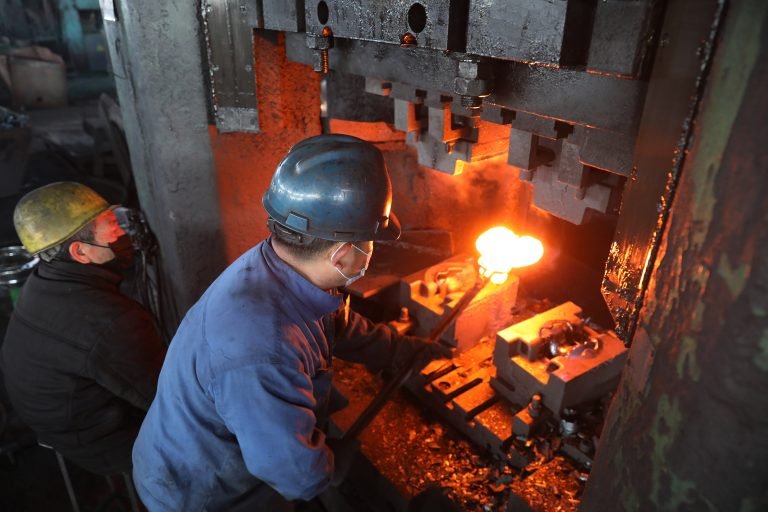
Cold forging is a metalworking process that uses compressive forces to shape a workpiece at room temperature. This process is used to create parts with high strength, precision, and surface finish. Cold forging is often used to manufacture parts for the automotive, aerospace, and medical industries.
There are many different types of cold forging processes, including:
- Closed-die forging: In closed-die forging, the workpiece is squeezed between two dies. This process is used to create parts with complex shapes and tight tolerances.
- Open-die forging: In open-die forging, the workpiece is hammered or pressed between two dies. This process is used to create parts with simple shapes and large volumes.
- Extrusion: Extrusion is a process in which a metal billet is forced through a die to create a long, continuous product with a specific cross-section. This process is often used to create parts for the construction, automotive, and electrical industries.
Cold forging offers several advantages over other metalworking processes, including:
- High strength: Cold forging increases the strength of the metal by up to 20%.
- Precision: Cold forging can produce parts with very tight tolerances.
- Surface finish: Cold forging produces parts with a smooth, high-quality surface finish.
- Waste reduction: Cold forging reduces the amount of waste produced during manufacturing.
However, cold forging also has some disadvantages, including:
- High cost: Cold forging is a more expensive process than other metalworking processes, such as casting or machining.
- Limited materials: Cold forging can only be used with certain types of metals, such as steel, aluminum, and copper.
- Complex dies: Cold forging requires the use of complex dies, which can be expensive to manufacture.
Overall, cold forging is a versatile and efficient metalworking process that can be used to create high-quality parts with tight tolerances. However, it is important to consider the cost and complexity of the process before deciding whether to use it.
Here are some additional characteristics of the cold forging process:
- High productivity: Cold forging is a highly productive process, as it can produce large numbers of parts in a short amount of time.
- Good dimensional accuracy: Cold forging can produce parts with very tight tolerances, which is important for many applications.
- Excellent surface finish: Cold forging produces parts with a smooth, high-quality surface finish, which can reduce the need for post-processing.
- Reduced material waste: Cold forging reduces the amount of material waste that is generated during manufacturing, which can save money and resources.
Cold forging technology offers several advantages over other manufacturing processes, including improved part strength, reduced material waste, and enhanced dimensional accuracy. These characteristics make it a preferred choice for producing high-quality metal components efficiently. It is a good choice for applications that require high strength, precision, and surface finish.