Basic performance of cutter materials
The choice of cutter material has a great influence on cutter life, machining efficiency, machining quality and machining cost. Cutters need to withstand high pressure, high temperature, friction, shock and vibration while cutting. Therefore, the cutter material should have some basic performance as follows:
1. Hardness and wear resistance: The hardness of the cutter material must be higher than the hardness of the workpiece material, which is generally required to be above 60 HRC. The higher the hardness of cutter material, the better the wear resistance.
2. Strength and toughness: Cutter materials with high strength and toughness are able to withstand cutting forces, shock and vibration, which prevents brittle fracture and chipping of the cutter.
3. Heat resistance: The heat resistance of the cutter material should be good, it needs to be able to withstand high cutting temperatures and have good oxidation resistance.
4. Technological performance and economy: Cutter material should have good forging performance, heat treatment performance, welding performance and grinding performance, but also the quest for cost-effective.
Further information of cutter materials
Diamond — An allotrope of carbon, the hardest material that has been found in nature.
Classification
1. Single crystal diamond: Natural diamond cutters are finely ground to an extremely sharp edge with an edge radius of up to 0.002μm, which enables ultra-thin cutting. The workpieces machined with it have extremely high precision and very low surface roughness, making it a recognized, ideal and irreplaceable cutter for ultra-precision machining.
2. Polycrystalline diamond (PCD): Due to the high price of natural diamond, PCD prepared by high-temperature and high-pressure synthesis technology was successfully developed in the early 1970s, natural diamond cutters have been replaced by PCD in many occasions. PCD raw material is available from plenty of sources, and its price is only a few tenths to a dozen tenths of that of natural diamond. However, PCD tools cannot be sharpened to an extremely sharp edge, and the surface of the processed workpiece is not as good as that of natural diamond. Therefore, PCD can only be used for precision cutting of non-ferrous metals and non-metals, and it is difficult to achieve ultra-precision mirror cutting.
3. Chemical vapor deposition (CVD) diamond: CVD diamond technology appeared in Japan in the late 1970s and early 1980s. CVD diamond refers to the synthesis of diamond films on cemented carbide or ceramics by CVD technology. CVD diamond has exactly the same structure and characteristics as natural diamond, and its performances are very close to those of natural diamond. CVD diamond combines the advantages of both single crystal diamond and PCD, and overcomes their shortcomings to a certain extent.

Capabilities
1. Extremely high hardness and wear resistance: the hardest substance that has been found in nature. When machining high hardness materials, the life of diamond cutter is 10 to 100 times that of carbide cutter, even up to several hundred times.
2. Low frictional coefficient: the lower friction coefficient with some non-ferrous metals than other materials which reduces the cutting forces during machining.
3. Excellent sharpness of cutting edge: can be as high as 0.002 to 0.008μm, enabling ultra-thin cutting and ultra-precision machining.
4. Superior heat conductivity: high thermal diffusivity, good for heat emission.
5. Low coefficient of thermal expansion: several times smaller than carbide, the change in cutter size caused by the cutting heat is very small, which is especially important for ultra-precision machining.
6. Poor thermal stability: will completely lose hardness when the cutting temperature exceeds 700 ℃ ~ 800 ℃.
7. Cannot be used for ferrous metals: react with iron atoms easily at high temperatures, carbon atoms will be transformed into graphite, which is highly susceptible to cutter damage.
Applications
Mostly used for precision cutting and boring of non-ferrous and non-metallic materials at high speeds. Suitable for machining wear-resistant non-metals such as fiberglass powder, metallurgical blanks, ceramic materials, etc. It can also machine a variety of non-ferrous metals.
Cubic boron nitride (CBN) — The second superhard material synthesized under high-temperature and high-pressure, one of the allotropes of boron nitride (BN), similar in structure to diamond.
Classification
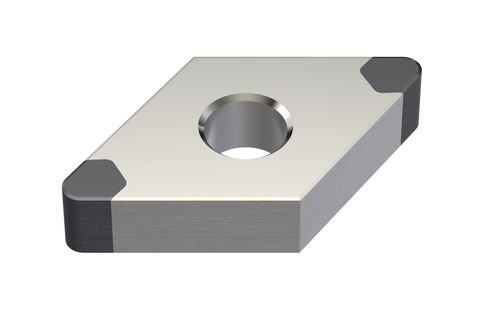
1. Polycrystalline cubic boron nitride (PCBN): A polycrystalline material produced by sintering fine CBN material with TiC, TiN, Al, Ti and other binders at high temperature and high pressure. Synthetic cutter material that is only second to diamond in terms of hardness.
Capabilities
1. High hardness and wear resistance: similar to diamond, it has a hardness and strength similar to that of diamond.
2. Excellent thermal stability: heat resistance is up to 1400-1500°C, twice as high as diamond.
3. Strong chemical stability: It does not react with ferrous materials and maintains its hardness even at temperatures over 1000°C.
4. Favorable thermal conductivity: second only to diamond, vastly superior to high-speed steel and carbide.
5. Low frictional coefficient: improve surface quality of machined parts.
6. Poor toughness and bending strength: not suitable for rough machining with low speed and high impact load, and also not suitable for cutting plastic materials such as aluminum alloy.
Applications
Suitable for precision machining of various quenched steel, cast iron, superalloys, cemented carbide, surface coating materials and other hard-to-cut materials. The machining accuracy is up to IT5 (IT6 for holes) and the surface roughness value can be as small as Ra1.25 to 0.20μm.
Ceramic– Developed from precision ceramics by high pressure, a product of modern high technology.
Classification:
1. Alumina ceramics: Aluminum oxide-based ceramic materials for thick film integrated circuits. There are two types of alumina ceramics, high purity and normal. High-purity alumina ceramics are ceramic materials with an alumina content of 99.9% or more, with a sintering temperature of 1650-1990°C and a transmission wavelength of 1-6μm. Normal alumina ceramics are divided into 99 ceramic, 95 ceramic, 90 ceramic, 85 ceramic according to the different alumina content, sometimes the alumina content of 80% or 75% is also classified as normal alumina ceramic.
2. Silicon nitride ceramics: An inorganic ceramic material that does not shrink when sintered. Silicon nitride is very strong, especially hot pressure sintered silicon nitride, which is one of the hardest substances in the world.

Capabilities:
1. High hardness and wear resistance: the hardness (can reach 93-95HRA) is not as high as PCD and PCBN, but it is much higher than that of cemented carbide and high-speed steel.
2. Superior heat resistance: cutting can still be performed at high temperatures above 1200°C, allowing for dry cutting, which eliminates the need for cutting fluid.
3. Strong chemical stability: not easy to bond with metal, corrosion resistant, which can reduce bonding wear on the cutter.
4. Low frictional coefficient: can reduce cutting forces and temperatures.
5. Poor toughness and bending strength: not suitable for cutting at low speed and impact load.
Applications
One of the cutter materials used for high-speed precision and semi-precision machining. Suitable for cutting and machining all kinds of cast iron (such as gray cast iron) and steel (such as high-strength steel, high manganese steel), and can also be used to cut copper alloy, graphite, engineering plastics and composite materials.
Coating– One of the most important ways to improve cutter performance.
Classification
1. Depending on the methods: Chemical vapor deposition (CVD), deposits at a temperature of around 1000℃ and physical vapor deposition (PVD), deposits at a temperature of around 500℃.
2. Depending on the matrix materials: Can be categorized as carbide-coated cutters, high speed steel coated (HSS-coated) cutters, and cutters coated on ceramics and super-hard materials (like diamond and cubic boron nitride).
3. Depending on the nature: Hard coated cutters (high hardness) and soft coated cutters (low friction).
4. Nanocoating: A variety of materials can be used in different combinations to meet different needs.

Capabilities
1. Excellent mechanical and cutting properties: maintains the good toughness and high strength of the matrix, but also has the high hardness, high wear resistance and low friction coefficient of the coating. The cutting speed of coated cutters can be more than two times higher than uncoated cutters.
2. Great versatility: wide machining range, one coated cutter can be used to replace several uncoated cutters.
3. Extended cutter life: with the increase of coating thickness the tool life also increases, but when the coating thickness reaches saturation, the life of the cutter no longer increases significantly.
4. Good flexibility: Cutters with different coating materials have different cutting properties.
Applications
Coated cutters have great potential in the field of CNC machining. Coating technology has been applied to a variety of tools such as end mills, reamers, drills and more. It can also meet the needs of high-speed cutting of various materials such as steel, cast iron and non-ferrous metals.
Cemented carbide–A powder-metallurgical two-phase material.
Classification
According to the main chemical composition, the International Organization for Standardization (ISO) classifies cemented carbides for cutting into three categories.
K, includes K10 to K40, equivalent to YG.
P, includes P01 to P50, equivalent to YT.
M, includes M10 to M40, equivalent to YW.

Capabilities
1. High hardness: a powder of one or several refractory carbides (tungsten carbide, titanium carbide, etc.) as the main component, and then metal powder (like cobalt and nickel) is added as a binder. Hardness 89-93 HRA, much higher than HSS. At 5400℃, the hardness is still up to 82-87HRA, which is the same as the hardness of HSS at room temperature.
2. Bending strength and toughness: the bending strength of commonly used cemented carbide is in the range of 900 to 1500 MPa. The higher the metal bond content, the higher the bending strength. Cemented carbide is a brittle material, its impact toughness at room temperature is only 1/30 ~ 1/8 of HSS.
Applications
YG: mainly used for machining cast iron, non-ferrous metals and non-metallic materials. Suitable for machining some special hard cast iron, wear-resistant insulating materials and more.
YT: high hardness, excellent heat resistance, higher hardness and compressive strength at high temperature than YG. Suitable for machining plastic materials such as steel, but not suitable for machining titanium alloys and silicon aluminum alloys.
YW: combining the properties of YG and YT alloys, it has good comprehensive performance and can be used for machining steel materials as well as cast iron and non-ferrous metals. Suitable for roughing and interrupted cutting of various difficult-to-machine materials.
High speed steel (HSS)– A tool steel with some added alloys.
Classification
Depending on the application, HSS can be categorized into universal and high performance.
1. Universal HSS: Generally can be divided into two categories: tungsten steel and tungsten-molybdenum steel.
2. High performance HSS: A steel type that adds some other elements to universal HSS. There are mainly the following categories: high-carbon HSS, high-vanadium HSS, cobalt HSS, aluminum HSS and nitrogen-containing super-hard HSS.

Capabilities
1. Red hardness: in the case of high heat generated by high-speed cutting (about 500 ℃) can still maintain high hardness, HRC can be more than 60.
2. Excellent heat resistance: maintains hardness of 48.5 HRC at 6,000°C.
3. Strong grindability: can be widely used to manufacture various complex cutters.
Applications
Used to manufacture a wide range of complex tools.
Principles of selection of cutter materials
Materials for cutters for CNC machining must be selected according to the workpiece to be machined and the nature of the machining. The selection of cutter materials should be reasonably matched with the machining object, mainly matching the mechanical properties, physical properties and chemical properties in order to obtain the longest cutter life and maximum productivity of cutting and machining.
Mechanical properties
The main point is to match the mechanical property parameters such as strength, toughness and hardness of the cutter and the workpiece material. Cutter materials with different mechanical properties are suitable for machining different workpiece materials.
The order of hardness: diamond > CBN > ceramic > cemented carbide > HSS
The order of bending strength: HSS > cemented carbide > ceramic > diamond and CBN
The order of toughness magnitude: HSS > cemented carbide > CBN, diamond and ceramic
The hardness of the cutter material must be higher than the hardness of the workpiece material, which is generally required to be above 60 HRC. The higher the hardness of the cutter material, the better the wear resistance.
Physical properties
Cutters with different physical properties are suitable for machining different workpiece materials. For example, when machining workpieces with poor thermal conductivity, cutter materials with better thermal conductivity should be used to reduce the cutting temperature by rapidly transferring the cutting heat.
Heatresisting temperatures:
Diamond: 700~8,000
CBN: 13,000~15,000
Ceramic: 1,100~12,000
Cemented carbide: 800~11,000
HSS: 600~7,000
The order of thermal conductivity: diamond > CBN > cemented carbide > HSS > ceramic
The order of coefficient of thermal expansion:
HSS > cemented carbide > ceramic > CBN > diamond
The order of thermal shock resistance: HSS > cemented carbide > ceramic > CBN > diamond
Chemical properties
It mainly refers to the matching of chemical property parameters such as chemical affinity, chemical reaction, diffusion and dissolution between the cutter material and the workpiece material.
The order of antioxidant temperature: ceramic > CBN > cemented carbide > diamond > HSS
The order of diffusion strength:
For steel: diamond > ceramic > CBN
For titanium: ceramic > CBN > diamond
Summary
Choosing the right CNC machining cutter material can be challenging, which is why you need to outsource to a specialized CNC service provider like us. CYCO offers a wide range of CNC machining services and can help you select the most appropriate CNC machining cutter material for your needs, which can help you save time and costs by improving machining efficiency.
We specialize in CNC machining processes for all types of materials.CYCO can select the most appropriate machining method for your needs and materials, and our dedicated team can provide expert advice on the selection of technologies.
Upload your design to get a instant quote now and feel free to contact us for more information.