Plasma cutting or water jet cutting? This is a question that is always being asked, but it doesn’t have an exact or definitive answer; the choice depends on what you value most.
To address this difficulty that people always face when choosing, here is a comparison of the two metal cutting solutions.
There is more than one way to perform a particular job in the manufacturing industry, especially when it comes to cutting raw materials, and the two most common technologies are water jets and plasma cutters.
Both machines are known for their ability to easily cut specific materials, but they have different capabilities and limitations.
What is Water Jet Cutting?
As the name implies, water jets aim a stream of water at an object to create a cut. Water jets use extremely high-pressure water to create enough destructive force to accurately cut metal, steel, plastics, titanium, and almost anything, from soft to hard materials.
For softer materials, pure water is used for cutting, this process is called pure water cutting (or pure water jet cutting).
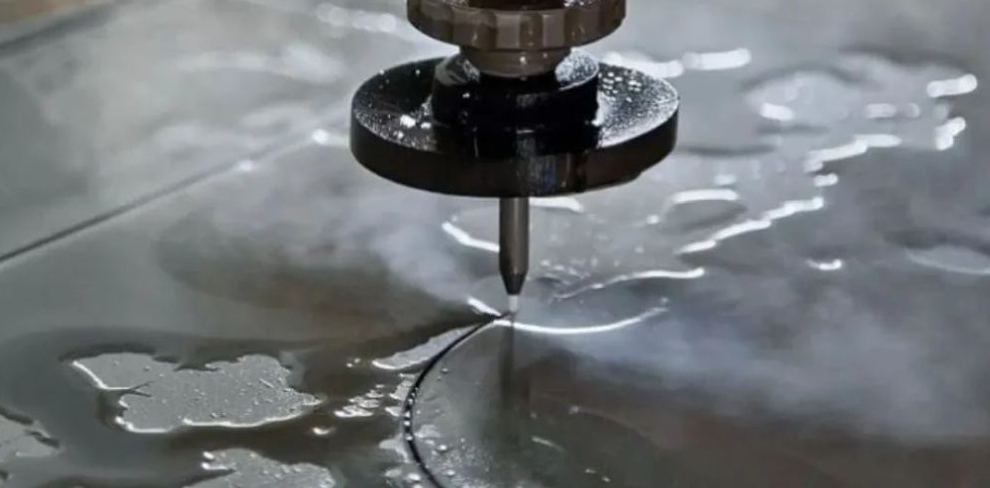
For harder materials, the cutting system mixes water with abrasive material, called abrasive water jet cutting, which increases the cutting force. The abrasive material is added at the nozzle, so it can also be used as a pure water jet cutter without abrasive material.
Water jet cutting may look innovative, but this highly effective cutting technique was introduced long ago. Water jet cutting gained attention as early as the 1930s, with paper cutting being one of the first commercial applications.
Extended reading: A Comprehensive Guide To Waterjet Cutting Technology
Water jet cutting offers several advantages, one of which is that there is no direct contact between the cutting tool and the material being cut.
It does not raise the temperature of the material during the cutting process, which makes it ideal for cutting surfaces where temperature regulation is critical, such as cutting conductive metals.
Pros and Cons of Water Jet Cutting
Pros
- Can cut almost anything.
- Does not create a heat affected zone, which is good for cutting heat sensitive materials.
- Does not produce any harmful fumes or waste.
- Highly accurate cutting.
- Works perfectly even on rough surfaces.
Cons
- Abrasives are expensive.
- Cutting process can be very noisy if it is not done underwater.
- Slow cutting speed for most metals.
What is Plasma Cutting?
On the surface, plasma cutting seems similar to water cutting, where the water jet is replaced by a high-pressure gas. However, plasma cutters are more technically complex and expensive with a different working process.
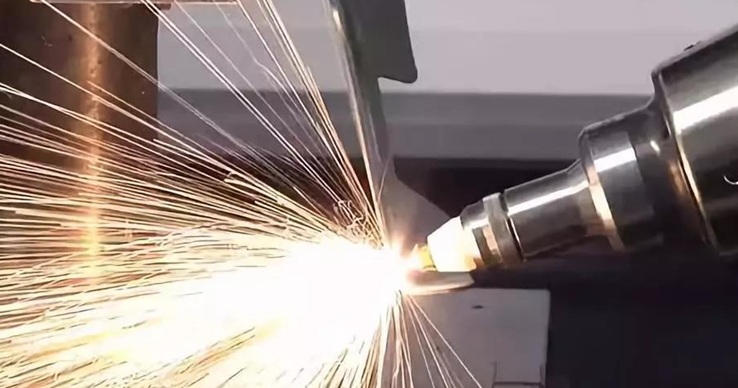
Plasma cutting utilizes a jet of gas whose atoms are electrically charged, and it can only cut materials that naturally conduct electricity. This method requires grounding the workpiece to act as a second electrode. When the charged gas falls on the material, it creates a complete circuit between the nozzle and the workpiece.
The circuit creates a high temperature at the contact point where the material melts and results in a precise cut, which is how a plasma cutter works. The molten metal is blown away by a high velocity gas to create a clean cut, and the welding industry uses a similar technique.
Plasma arc cutting appeared in the 1960s and is a new technology compared to water jet cutting.
Pros and Cons of Plasma Cutting
Pros
- Can cut all kinds of metals.
- Easy to learn and operate.
- Faster cutting speed.
- Excellent hole quality.
Cons
- Creates a huge heat affected zone.
- Less accurate than a water jet.
- Micro-cracking of certain metals during the cutting process.
- Generates toxic fumes.
Difference between Plasma Cutting and Water Jet Cutting
Selection of Materials
Material Flexibility
When it comes to material flexibility, the water jet has the upper hand.
On the one hand, the water jet can cut almost all materials, and in addition to common metal materials including steel, aluminum, and copper, it can also cut other materials such as polystyrene foam, rubber, textiles, and paper.
On the other hand, plasma cutting technology creates a plasma arc for cutting by combining electrons with a gas, which can only cut conductive metals. This limits its cutting ability compared to water jets.
In terms of material selection, water jet cutting is superior.
Material Thickness
Another factor that distinguishes plasma cutting from water jet cutting.
Water jet cutters can cut steel or stainless steel up to 6 inches thick and other materials up to 18 inches thick. In addition, when used for coal mining, the technology can cut up to 100 feet thick.
Plasma cutting has a limited depth of cut and can only cut low-carbon steel up to 6 inches.
However, both technologies work best on metals with standard thicknesses.
Lifespan
In a plasma cutter, the consumables needed for each job wear out quickly when the machine is started. Components like nozzles may only last a few hours.
Consumables for water jet cutting last much longer, with nozzles lasting around 100 hours and other components lasting much longer, for example pressure pumps can last around 10,000 hours.
In terms of consumable life, water jet cutting has a cost-effective advantage compared to plasma cutting machines. The reduced need to replace consumables also means lower labor costs.
Precision and Accuracy
Water jet cutting excels when it comes to accuracy. It can achieve complex cuts with tolerances as high as 0.005 inches, making it ideal for applications that require high precision, such as aerospace components and intricate designs.
Plasma cutting is often very precise, but not as accurate as water jet cutting, especially for complex shapes and fine details.
Productivity and Cutting Speed
Factors that affect speed include material type, cutting complexity, material thickness and design accuracy. When cutting thick sheet metal, plasma cutting is the fastest, with an average cutting speed of about 200 inches per minute.
In contrast, water jets are slower, with an average cutting speed of 15 inches per minute.
As the cutting speed increases, productivity increases when cutting metal using plasma cutting techniques.
Stress Caused by Cutting
Plasma cutting accomplishes the cutting process by generating ultra-high temperatures at the edges. As a result, it can cause some stresses in the material, such as warping or distortion.
Water jet cutters do not generate any intense heat and do not cause stress on the material.
If the material you are cutting is sensitive to stress, water jet cutting produces a better cut quality.
Heat Affected Zone
Plasma cutting uses high temperatures to melt the material, and the gas creates a chemical reaction near the melted part, which can change the color and chemical composition of the material adjacent to the cut, called the heat-affected zone. However, water jet cutting has no heat affected zone.
Similarly, water jet systems are a better choice for maintaining the overall quality and integrity of the material to minimize any heat-related effects.
Environmental Protection
Plasma cutting produces fumes, which makes it less environmentally friendly than water jet cutting. In addition, the melted metal reacts with water and gas to form cutting waste.
Water jet cutting is a closed-loop operation, and the water used for cutting is recycled during the process. Moreover, all metal discharged from the cut can be recycled as scrap metal.
For an environmentally friendly operation, choosing water jet cutting is a no-brainer.
Secondary Finishing
Due to the heat-related effects and lower accuracy of plasma cutters, some secondary finishing of the cut, such as fine grinding, is required to improve edge quality.
Water jet cutting does not require further finishing of the cut area because the cut is already accurate.
Labor for secondary finishing can be saved by choosing water jet cutting.
Energy Consumption
Plasma cutting requires high pressure gas and a high current arc, which consumes a lot of energy. Water jet cutting only requires a high-pressure water pump, which consumes much less power.
Water jet cutting machines have a significant advantage over plasma cutting machines in terms of energy consumption, with plasma cutting machines consuming more than twice as much energy as water jet cutting machines.
Safety
Water jet cutters are relatively safe due to the complete absence of heat and electric current. Plasma cutters generate electricity and heat at very high temperatures, so the process requires extensive safety training before handling.
It is also recommended that manufacturers using plasma cutting technology use goggles or glasses as the technology can be dangerous to the eyes.
Maintenance
Since water jet cutting does not involve complex equipment, the maintenance process is simple. On the other hand, plasma cutting maintenance is a bit more complicated due to frequent replacement of worn nozzles and electrodes.
When to Choose Water Jet Cutting
Reasons why you should choose water jet cutting:
- Higher accuracy and precision due to very low tolerances.
- It is a more environmentally friendly technology where water and metal can be recycled in the process.
- It is very suitable for cutting materials that do not melt easily such as granite.
- It is ideal for cutting materials that melt easily when subjected to heat.
- Water jet cutting occurs at lower temperatures and there is no heat affected zone.
When to Choose Plasma Cutting
Here are some advantages of choosing plasma cutting:
- Fast cutting at 200 inches per minute increases productivity and saves time.
- A cheaper process because it has cheaper upfront and operating costs than using waterjets.
Conclusion
There is no clear winner between water jet and plasma cutters as there are many variables that need to be evaluated before choosing any one of them.
I believe this article provides you with a quick overview of the differences between these two different cutters so you can choose or decide for yourself.
The results should depend on your priorities.
Why CYCO
If you want to manufacture precision parts, make sure you choose a certified CNC machining service provider. At CYCO, we offer a wide range of precision cutting services, including plasma cutting, water jet cutting and more.
We have a strong and dedicated team to help ensure that the produced parts are of high quality. All you need to do is share your idea or design with us for a quick quote and free analysis.
Do not hesitate to contact us now!