There are several fabrication methods to choose from when it comes to manufacturing metal parts. Two common options are casting and CNC machining. But what factors should you focus on when determining the best fabrication method for your project?
This article discusses the pros and cons of both metal fabrication methods, provides guidance on choosing the right method, and summarizes the differences between the two methods.
What is Casting?
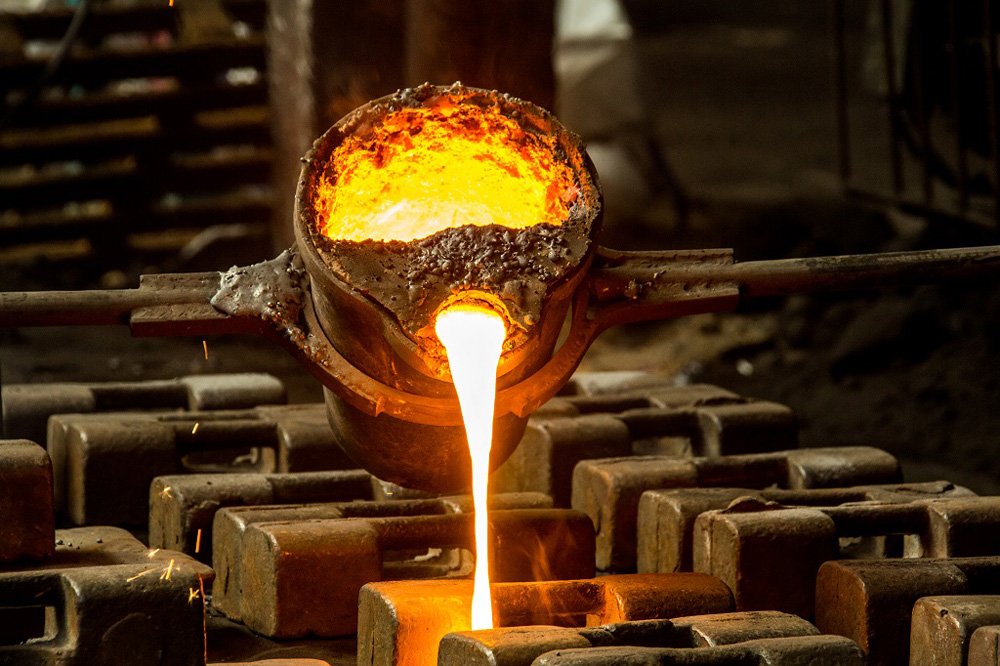
Metal casting is a manufacturing technique in which molten metal is poured or injected into a pre-fabricated mold, sometimes referred to as a die, and the metal part is removed from the mold after it cools until fully solidified.
If complex internal geometry or cavities are required, cores or inserts are used. In some cases, additional CNC machining can be used as a secondary operation to further refine the cast metal part and achieve tighter tolerances.
There are many different metal casting techniques that can be used, depending on the selected material, casting size, casting shape and more. Some of the most commonly used casting methods include die casting, sand casting, pressure casting and investment casting.
Various parts can be produced through casting, such as turbine blades, train wheels, bus treads, and engine blocks. Castings are used in all industries including aerospace, automotive, consumer products and medical devices.
Pros of Casting
- Casting offers extensive design possibilities, allowing the creation of complex and unique shapes, including complex internal cavities.
- For high-volume production, casting may be cost-effective compared to CNC machining. Furthermore, casting is faster in production time.
- The use of reusable molds in casting ensures a high level of repeatability because copies of the same part can be created consistently.
- Casting is very efficient in metal usage. Almost all of the metal used in the process becomes part of the final product. Any excess metal or non-conforming parts from the casting process can be easily melted down and recycled.
Cons of Casting
- Techniques such as die casting and precision investment casting offer high precision, but CNC machining is often a better choice for accuracy and achieving tight tolerances.
- In smaller production runs, cast parts are usually more expensive than CNC machining.
- Production of cast parts usually takes more time due to design and tooling requirements.
- There are limitations in the selection of metal materials available for casting compared to CNC machining.
- Casting typically requires additional post-processing steps, such as removing excess casting or using sandblasting to eliminate burrs.
What Is CNC Machining?
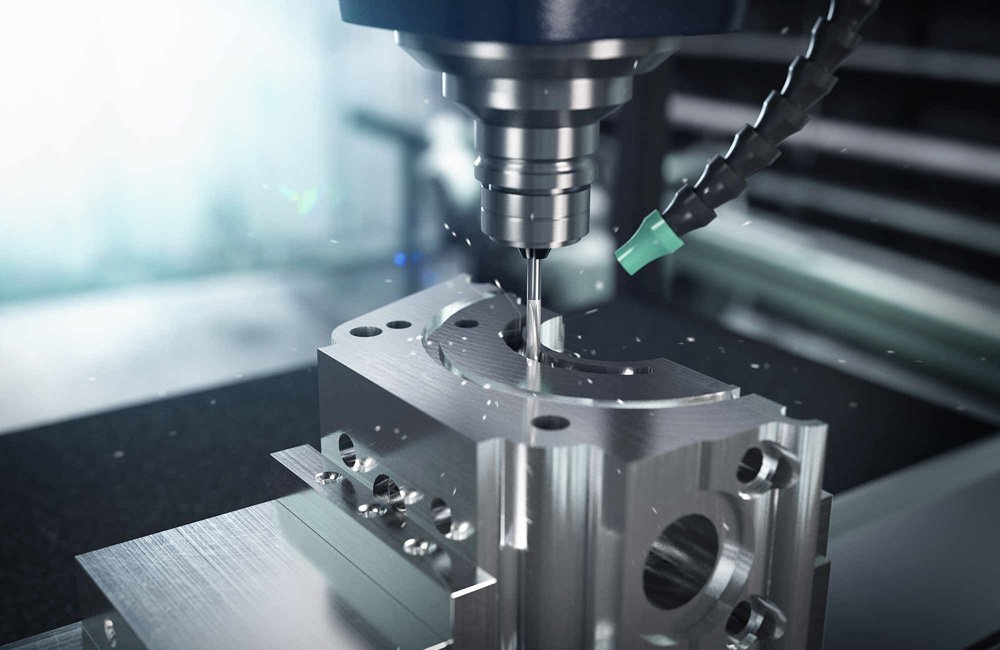
CNC machining is a subtractive manufacturing process that uses cutting tools to remove material and achieve the desired shape. To control the machining process, a computer program is often used to direct the equipment and CNC machine.
CNC machining can refer to several different types of machining. These include traditional machining processes such as CNC turning, milling, drilling, boring, and sawing, as well as modern, non-conventional machining processes such as laser cutting, wire cutting, and abrasive water jet cutting. The choice of process depends on the specific requirements.
CNC machined parts have a wide range of applications in different industries. They are vital in the manufacture of metal laptop casings, small components in cell phones, and basic components used in aerospace and automotive parts.
Pros of CNC Machining
- CNC machining produces highly accurate parts with precise dimensions and smooth surfaces that meet stringent quality requirements.
- It is often faster than casting processes when machining unique or small quantities of parts.
- CNC machined parts are less expensive for small production runs and prototyping.
- CNC machining is compatible with a wide range of metals, making it a versatile process.
Cons of CNC Machining
- CNC machining is less suited to creating internal cavities in a part and more suited to shaping external geometry.
- It is very costly for high volume production.
- Parts with complex designs or specific materials may require longer machining times.
- CNC machining produces more metal scrap than casting, and the recycling process can be more cumbersome. Often the waste needs to be shipped off-site for proper recycling.
Choose the Right One Between Casting and CNC Machining
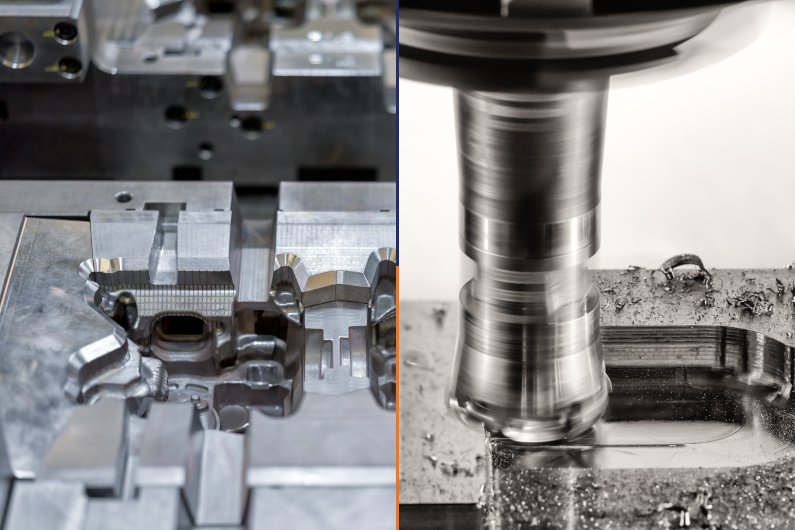
The specific requirements of the shape and dimension of the part will influence the choice of fabrication process.CNC machining and casting both have their own advantages, so how can we decide which one to use?
In general, CNC machining is the preferred method for prototyping unique parts or quickly producing small to medium production runs. So choose CNC machining when you have very strict requirements for part accuracy and surface finish.
Metal casting is the preferred method for producing large quantities of the same product. It can also be used to produce complex internal cavities that are challenging or cannot be reconstructed by other methods.
The following are some other factors that need to be taken into consideration when determining the appropriate fabrication method for your part:
Based on Delivery Time
When time is a critical factor, CNC machining offers significant advantages. CNC machined parts can be produced within hours after creating a CAD model. The reason why casting takes more time is that it involves creating a mold and setting up the casting process.
Even if the final choice is to produce via casting, CNC machining offers a faster option. It allows parts to be modeled, machined, and tested at a lower cost than cast prototypes.
Based on Volume
In some cases, the choice of fabrication process may be clear. If you need a large number of parts, casting is usually more cost-effective. Although it takes time to create the initial mold, each casting can be produced quickly and at a lower added cost. CNC machining can produce the first few parts faster and more cost-effectively, but it becomes less cost-effective as production volumes exceed a certain level.
When choosing a fabrication method, the primary consideration is the required volume of production. CNC machining should be considered for small production runs of a few dozen or a few hundred. For quantities over 10,000 or more, casting would be more appropriate.
Certainly, various factors will influence the best choice of fabrication method. In some cases, large quantities of cast parts may still require additional machining due to specific requirements. This may increase the total cost of the part, but sometimes performance is more important than cost.
Based on Part Geometry
It is critical to consider the geometry of the part when selecting an appropriate fabrication technique. Designs that require significant material removal can be very time consuming and wasteful. In such cases, casting is often a suitable option, especially for hollow parts with thin walls, large internal spaces, and complex geometries that require very long machining times.
Internal cavities are often more challenging for CNC machining. Instead, casting simplifies the design and eliminates the need to assemble multiple small parts and the entire part can be cast as single parts.
However, using casting to create certain features can be challenging. For example, sharp edges or corners are not well suited for casting. Additionally, large, thick-walled or irregularly shaped parts are difficult to fill and cool evenly during the casting process.
Based on Materials
Casting produces less scrap than CNC machining. Only the material needed for the final part is used in the casting process, and the excess metal flows out of the channel and can be reused in other parts.
However, casting offers fewer material options than CNC machining. Almost all alloys can be CNC machined, but the range of alloys suitable for casting is more limited.
Based on Production Speed
The process of casting molds usually takes a few weeks from start to finish. Once the mold is ready, the casting process is quick, making it suitable for producing large quantities of parts. However, the mold will also need to be quality checked and maintained, which will also take some time.
CNC machining, on the other hand, offers faster production speeds; it requires only CAD models, CAM programs, CNC machine tools, and expertise to start producing parts, allowing for faster handling of small batches of parts.
Based on Repeatability and Accuracy
The casting process excels in producing consistent parts, where each part can be manufactured to be exactly the same.
CNC machining of metal is also a highly repeatable and precise process that allows for tighter tolerances than casting. For standard metal fabrication, it is reasonable to expect a tolerance of 0.025 mm (0.001 inches).
Comparison for Reference
| Casting | CNC Machining | |
| Manufacturing process | Formative manufacturing process, pour molten material into a mold. | Subtractive manufacturing method, remove material from a solid block or piece using cutting tools. |
| Complex shapes | Intricate internal and outer features. | Parts with complex geometry and shape. |
| Surface finish | Often require secondary processing. | Smooth |
| Tolerance | Not as tight as CNC machining. | Dimensionally accurate with smooth surfaces. |
| Delivery time | Time-consuming in small batches. | Significantly faster for prototyping and low volumes. |
| Cost | Low costs for large production runs. | Cost savings for small batches and prototyping. |
| Volume | Ideal for large-volume production. | More cost-effective for small batch and prototype manufacturing. |
| Material | Usually suited for alloys with lower melting points. | Versatile for most metals. |
| Customization | Limited | More flexible. |
| Automation | Require manual labor. | Automatic |
| Speed | Relatively slow. | Faster |
| Versatility | Limited by the mold design. | More versatile in terms of shapes, sizes, and complexities of parts. |
Conclusion
Ultimately, the choice between casting or CNC machining depends on the specific situation. As we’ve discussed in this article, each fabrication method has its own pros and cons. For unique needs, creativity is required to find the best solution.
In some cases, a combination of casting and precision CNC machining may be the most efficient and reliable method of producing parts. Parts produced through this method are referred to as machined castings.
Why CYCO
If you are experiencing any uncertainty or difficulty, contact CYCO to discuss your project or idea with us. With over twenty years of machining experience, we can provide effective guidance to help you make a wise decision.
We provide reliable and professional services for die casting, precision casting and CNC machining, our goal is always to help you produce high quality products quickly at a reasonable cost. No matter which type of machining you choose, CYCO can meet your needs.
If you have any ideas, feel free to contact us now!