Mechanical properties of steel
1. Yield point (σs)
When stretching steel or specimen, if the stress exceeds the elastic limit, even if the stress is no longer increased, the steel or specimen continues to experience significant plastic deformation, the phenomenon is known as yielding. The minimum stress value at which yielding occurs is the yield point.
2. Yield strength (σ0.2)
The yield point of some metallic materials is extremely insignificant and difficult to measure. For metal materials with no obvious yielding phenomenon, the stress value that produces 0.2% residual deformation is specified as its yield limit, which is called the conditional yield limit or yield strength.
3. Tensile strength (σb)
The value of the maximum stress reached from the beginning of the tensile process to the time when fracture occurs. It indicates the ability of steel to resist fracture, corresponding to the compressive strength, bending strength, and so on.
4. Elongation (δs)
The percentage of the length of plastic elongation of a material after it has been drawn off compared to the length of the original specimen.
5. Yield ratio (σs/σb)
The ratio of the yield point (yield strength) to the tensile strength of steel. The bigger the yield ratio, the higher the reliability of the structural part. The yield ratio is generally 0.6-0.65 for carbon steel, 0.65-0.75 for low-alloy structural steel, and 0.84-0.86 for alloy structural steel.
6. Hardness
Hardness indicates the ability of a material to resist hard objects pressed into its surface, which is one of the important performance targets of metal materials. Generally, the higher the hardness, the better the wear resistance. There are three commonly used hardness indicators.
1) Brinell hardness (HB)
A hardened steel ball of a certain size (generally 10mm in diameter) is pressed into the surface of the material with a certain load (generally 3000kg). After holding the load for a while, the ratio of the load to the area of the indentation is HB.
2) Rockwell hardness (HR)
When HB is greater than 450 or the specimen is too small, the Brinell hardness test cannot be used and Rockwell hardness measurement is used to instead.
It is a diamond cone with a point angle of 120° or a steel ball with a diameter of 1.59 or 3.18 mm, which is pressed into the surface of the measured material under a certain load, and the depth of the indentation is used to calculate the hardness of the material.
Depending on the hardness of the test material, it is expressed in three different scales:
HRA: The hardness is obtained by using a 60kg load and a diamond cone indenter, and it is used for extremely hard materials (such as cemented carbide).
HRB: Hardness obtained by using a 100kg load and 1.58mm diameter hardened steel balls, used for lower hardness materials (such as annealed steel and cast iron).
HRC: The hardness is obtained by using a 150 kg load and a diamond cone indenter for highly hard materials (such as quenched steel).
3) Vickers hardness (HV)
A load of 120kg or less and a diamond square cone indenter with an point angle of 136° are pressed into the surface of the material, and the HV is obtained by dividing the surface area of the indentation crater in the material by the load value.
Classification of steel
The main elements of steel are iron and carbon, but also silicon, manganese, sulfur, phosphorus and so on.
Steel classifies differently, and some main methods are as follows:
1. Classified by quality
1) Normal steel: P≤0.045%, S≤0.050%
2) High-quality steel: P, S≤0.035%
3) Superior high quality steel: P≤0.035%, S≤0.030%
2. Classified by chemical composition
1) Carbon steel
Low carbon steel: C≤0.25%
Medium carbon steel: 0.25≤C≤0.60%
High carbon steel: C≥0.60%
2) Alloy steel
Low alloy steel: alloy elements≤5%
Mediumalloy steel: 5%~10%
Highalloy steel: alloy elements≥10%
3. Classified by molding method
1) Forged steel
2) Cast steel
3) Hot rolled steel
4) cold stretched steel
4. Classified by micro structure
1) Annealing
Hypoeutectoid steel (ferrite + pearlite)
Eutectoid steel (pearlite)
Hypereutectoid steel (pearlite + cementite)
Iedeburitic steel (pearlite + cementite)
2) Normalizing
Pearlitic steel
Bainitic steel
Martensitic steel
Austenitic steel
3) No phase transition or partial phase transition
…
Steel for CNC machining
Steel is one of the many materials well-suited for CNC machining. There are a variety of steel grades to choose from for CNC machining, all of them offering unique properties. Here are some common grades:
1018 steel — A low carbon steel
This steel grade contains iron, carbon, manganese, phosphorus and sulfur, and the chemical composition content is listed below for reference.
C: 0.7-0.24
Si: 0.17-0.37
Mn: 0.70-1.00
S: ≤0.035
P: ≤0.036
Cr: ≤0.25
Ni: ≤0.25
Cu: ≤0.25
The greatest advantage of 1018 in CNC machining is its good weldability, but only after carburizing. 1018 steel also has excellent machinability, such as turning and milling, and is widely used in the manufacture of pistons, screws, drive shafts, machine tools, and other CNC machined parts. Its mechanical properties are as follows:
Density (g/cm3): 7.87
Elongation at break: 15%
Yield tensile strength (MPa): 310
Hardness (Brinell): 131
Shear modulus (GPa): 78
1215 steel — An environmentally friendly material
Free of Pb and environmentally hazardous substances, good cutting properties. It is mainly used for the production of instrument and watch parts which are subject to less force but have strict requirements on size and finish. In addition, it is also used to manufacture standard parts with lower mechanical property requirements, such as gears, shafts, bolts and more.
Chemical composition of 1215 steel (%):
C :≤0.09
Mn :0.75-1.05
P :0.04-0.09
S :0.26-0.35
Mechanical properties of 1215 steel:
Density (g/cm3): 7.87
Elongation at break: 10%
Yield tensile strength (MPa): 415
Hardness (Brinell): 167
Shear modulus (GPa): 80
1045 steel — Higher strength medium carbon quality steel
Because of poor hardenability, generally used in the state of normalizing, annealing and normalizing of the cutting and machinability better than quenching and tempering. It is used to manufacture parts with high strength requirements, such as gears, shafts and piston pins.
Chemical composition of 1045 steel (%):
C:0.43~0.50
Si:0.17~0.37
Mn:0.60~0.90
S:≤0.050
P:≤0.040
Cr:≤0.25
Ni:≤0.25
Cu:≤0.25
Its mechanical properties:
Density (g/cm3): 7.87
Elongation at break: 12%
Yield tensile strength (MPa): 450
Hardness (Brinell): 170
Shear modulus (GPa): 60
4130 steel — Steel with high strength and toughness
This kind of steel has good thermal strength and sufficient high-temperature strength up to 500°C, but its strength decreases significantly at 550°C. Welds quite well when the alloying elements are at the lower limit, but is moderately weldable near the upper limit and needs to be preheated to above 175°C before welding. Also it has good machinability and medium plasticity in cold deformation.
Its chemical composition:
C:0.28~0.33
Si:0.15~0.35
Mn:0.40~0.60
S:≤0.040
P:≤0.035
Cr:0.80~1.10
Ni:≤0.030
Cu:≤0.030
Mo:0.15~0.25
Its mechanical properties:
Density (g/cm3): 7.87
Elongation at break: 20%
Yield tensile strength (MPa): 460
Hardness (Brinell): 217
Shear modulus (GPa): 80
4140 steel — An alloy structural steel
High strength and high hardenability, good toughness, small deformation during quenching, high creep strength and stress-rupture strength at high temperature. For the manufacture of large gears, supercharger drive gears, rear axles, extremely loaded connecting rods and spring clamps for locomotive traction.
Its chemical composition:
C:0.38~0.43
Si:0.15~0.35
Mn:0.75~1.00
S:≤0.040
P:≤0.030
Cr:0.80~1.10
Ni:≤0.030
Cu:≤0.030
Mo:0.15~0.25
Its mechanical properties:
Density (g/cm3): 7.87
Elongation at break: 19%
Yield tensile strength (MPa): 655
Hardness (Brinell): 197
Shear modulus (GPa): 80
Three techniques for steelmachining
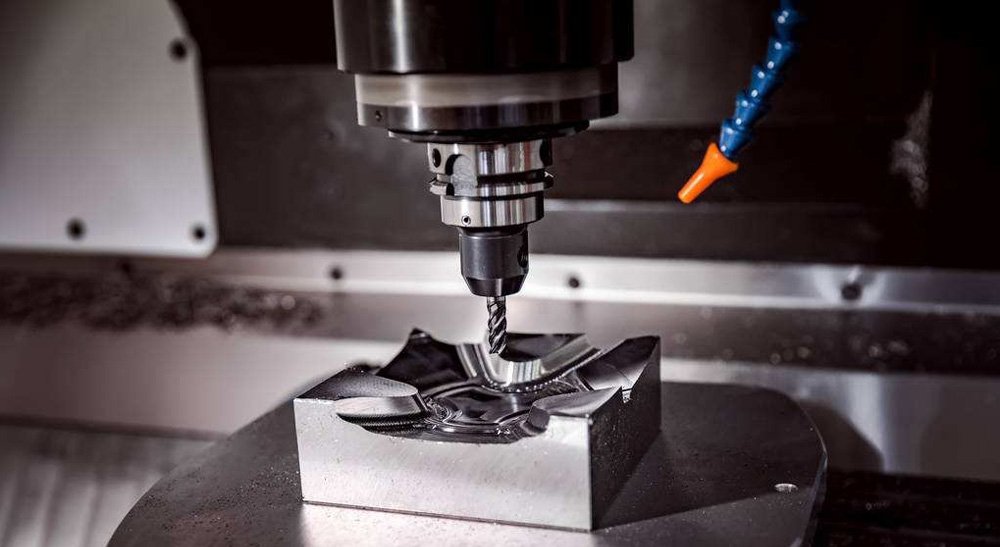
When machining steel parts by CNC, some machining methods are often used to improve the cutability and machinability of the steel, or to treat the steel parts after machining to enhance their hardness or strength. Three common steel machining processes are described below.
1. Heat treatment
Changing the properties of steel through temperature, including annealing, normalizing, quenching and tempering techniques.
Annealing is the process of heating steel slowly to a certain temperature and cooling it slowly to room temperature by holding it for a while. Annealing improves residual stresses to prevent distortion and cracking of the workpiece, and also improves the mechanical properties of the workpiece, which prepares it for the final treatment (quenching, tempering).
Normalizing is the process of heating steel to 30-50°C above its critical temperature, cooling it in air by holding it for an appropriate period of time. (Cooling rate: quenching > normalizing > annealing) Normalizing enhances the hardness and improves the machinability of low carbon and low carbon alloy steels. Normalizing is more economical and it also stabilizes the organization of the steel.
Quenching is the process of heating steel above a critical temperature and then holding it for a period of time to fully or partially austenitizing. It is then cooled at a rate greater than the critical cooling rate to make the martensite (or bainite) transformation. The hardness of quenching is high, but the internal structure of the quenched martensite organization is not balanced, if not tempered in time will produce deformation or even cracking.
Tempering is the process of heating hardened steel or parts to a temperature below the critical temperature, holding it for a certain period of time before cooling it to room temperature. Tempering reduces the internal stress and brittleness of quenching, improves the hardness, strength, plasticity and toughness of quenched parts, and meets the different performance requirements of various workpieces.
Quenching + tempering can reach the effect of 1 + 1 > 2.
2. Precipitation hardening
Precipitation hardening steels contain elements such as copper, aluminum, phosphorus and titanium, which increase the strength of the steel and keep it tough enough.
3. Cold metal working
In contrast to hot working, cold working is a machining process in which the metal is plastically deformed at a temperature below the recrystallization temperature. Cold working improves the machinability of steel, which can be made stronger by the work-hardening process.
Surface treatment of steel parts
Surface treatment is a process that follows the completion of metal parts in order to improve the functionality and aesthetics of these parts. Different metals require different surface treatments. For steel parts, the following common surface treatments are available.
Powder Coating
Dry powder is deposited on the surface of steel parts, the coating is generally 0.15-0.3mm in thickness and is used to increase the corrosion resistance of the parts.
Carburizing
Carburizing is used mostly for low carbon or low alloy steels, heating the steel in the presence of carbon-containing materials (such as carbon monoxide and charcoal) to enhance the hardness and resistance to wear of CNC steel parts.
Nickel plating
About 0.1mm of nickel is plated on the surface of the steel parts to improve the corrosion and wear resistance of the steel parts.
Lapping
Removing irregularities from the surface of a steel part to smooth the surface with abrasive wheels.
Pros and cons of CNC steel machining
Steel is one of the most difficult materials to machine, but the benefits from using steel parts often exceed the difficulties. Machining steel parts requires a great deal of experience and skill in order to achieve the desired results.
Pros:
Most of the steel alloys on the market now are well machinable, meaning that steel can be easily cut to get the desired part structure, while the high precision of CNC machining makes it possible to produce high quality parts.
Another advantage of CNC steel parts is that the products are highly resistant to corrosion and abrasion, which will extend the service life and usage cycle of the parts. In addition to this, steel parts can be subjected to a number of surface treatments and machining processes to improve their performance for a wide range of usage situations.
Cons:
Despite the many benefits, not all steel parts are machinable, accuracy and quality can be affected for steels with poor machinability.
In addition, steels behave differently at high temperatures and some even melt. The high heat of machining can have an effect on the microstructure of some materials.
Summary
In conclusion, steel is a versatile material, but how you make your choice depends on what you want in your final product. CYCO can provide CNC machining services for the steel parts you want. Contact us if you have machining service needs.
In order to avoid wasting your valuable time, you can choose CYCO as your partner without any hesitation!
Work with us for a worry-free experience now!