Centrifugal casting is a process that utilizes centrifugal force to create metal castings, and is primarily used to produce metal castings in various shapes, especially those with cylindrical or hollow sections.
Overview of Centrifugal Casting
Centrifugal casting is a metal casting process. The main feature is that the centrifugal force generated by rotating the mold causes the liquid metal to be evenly distributed on the inner wall of the mold and solidify into shape. The centrifugal force allows the liquid metal to better fill all parts of the casting mold, and good mold filling can be achieved, especially for complex shapes and hollow parts. This casting method is commonly used to produce hollow parts such as pipes, hubs, fan blades, and other parts that require special shapes.
Centrifugal casting is widely used in various industries including, but not limited to, aerospace, automotive manufacturing, marine, power equipment, petrochemical, metallurgy, and construction.

Workflow of Centrifugal Casting
- Mold preparation: Prepare a mold that can be rotated and apply refractory coating on the surface. The appropriate mold material will be chosen according to the material and shape of the casting, which can be sand, metal or ceramic. If necessary, preheat the mold to reduce the cooling rate and prevent cracks or deformation of the casting.
- Injection of liquid metal: Select the appropriate metal or alloy and heat it to a liquid state. Before pouring, the metal liquid can be filtered with a filter, such as a foam ceramic filter or fiberglass filter, to remove impurities and slag from it. Then, the pouring speed and temperature are controlled and the liquid metal is poured quickly and smoothly into the rotating mold to ensure that the liquid metal is able to fill the mold uniformly by centrifugal force.
- Rotation and solidification: Once the liquid metal has filled the mold, rotation of the mold begins. The centrifugal force generated by the rotation of the mold distributes the liquid metal along the inside walls of the mold, gradually filling the entire mold. As the mold rotates, the liquid metal begins to cool and solidify inside the mold walls. The centrifugal force helps to ensure that the metal is evenly distributed within the mold, forming hollow or specifically shaped parts. Note that the choice of rotational speed and rotation time affects the internal structure and mechanical properties of the casting.
- Cooling and demolding: As soon as the casting is fully solidified, the rotation of the mold is stopped and it is cooled. Natural cooling, water cooling or other cooling methods can be used to ensure that the casting is fully solidified. After cooling to a certain temperature, open the mold and remove the finished product.
- Cleaning and machining: Clean the sand, burrs and other residues from the surface of the casting to ensure the quality and appearance of the casting. According to the needs, the castings can also be heat-treated, machined, surface-treated and other post-treatment processes to improve their performance and surface quality.
Types of Centrifugal Casting
Types of Centrifugal Casting Machines
- Vertical centrifugal casting machine: One of the most common types of centrifugal casting machine. In a vertical centrifugal casting machine, the mold is placed vertically and the centrifugal force generated by rotation distributes the liquid metal along the inner wall of the mold. This type of machine is suitable for the manufacture of larger diameter pipes, hubs, and other parts.
- Horizontal centrifugal casting machine: In contrast to vertical centrifugal casting, the mold is placed horizontally. This type of machine is usually used for manufacturing shorter length pipes and shaft-like parts.
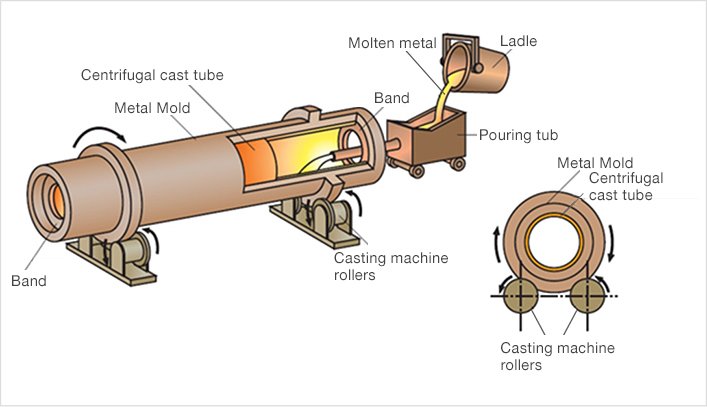
True Centrifugal Casting
A specialized casting process that uses only centrifugal force to drive the liquid metal to fill the mold and solidify into shape, without relying on gravity or other auxiliary forces. Due to the role of centrifugal force, the casting grain structure is usually more uniform and fine, which is conducive to improving its mechanical properties and corrosion resistance. True centrifugal casting can reduce or eliminate the porosity, inclusions and shrinkage holes inside the casting, as well as improve the density and mechanical properties of the casting.
How it Works
- Pour molten liquid metal into a rotating mold.
- Rotate the mold continuously at a certain speed and direction to generate enough centrifugal force to distribute the liquid metal along the inner walls of the mold.
- Stop the rotation of the mold once the metal has completely solidified.
- Open the mold and remove the finished product. Post-treat the casting if necessary.
Applications
Due to its complete reliance on centrifugal force, this casting method is particularly well suited to the manufacture of castings with complex internal shapes, hollow sections or thin-walled structures. Common products include pipes, turbine blades, inner and outer rings for bearings, gun barrels, marine propellers, bushings, flanges, and other parts with special shapes or requirements.
Semi-Centrifugal Casting
In the semi-centrifugal casting process, the filling of the liquid metal depends on both gravity and centrifugal force. The effect of centrifugal force in semi-centrifugal casting is relatively weak compared to ture centrifugal casting, and is mainly used to assist in the flow and distribution of the liquid metal. In this process, the mold is usually tilted rather than perfectly vertical. This method allows centrifugal force to be used in the tilted state of the mold to produce parts of a specific shape.
How it Works
- Pour molten liquid metal into a rotating mold.
- The mold generates some centrifugal force by rotating at a lower speed while the liquid metal flows downward and fills the mold by gravity.
- Once the liquid metal fills the mold, it starts to rotate the mold. The centrifugal force generated by the rotation of the mold acts along the tilt of the mold, pushing the liquid metal to one side of the mold.
- As the metal is distributed within the mold, the liquid metal begins to cool and gradually solidify. The centrifugal force helps to ensure that the metal solidifies uniformly throughout the thin layer, especially for castings with curved or sloped surfaces.
- As soon as the metal has completely solidified, stop the rotation of the mold.
- Open the mold and remove the finished product. Post-treat the casting if necessary.
Applications
Suitable for the production of castings with a certain degree of internal complexity but which do not depend entirely on centrifugal force to be molded, especially castings with more complex shapes but which do not entirely belong to a tubular or cylindrical structure, such as conical or beveled shaped parts. It can improve the density of castings and reduce internal defects, but the degree of improvement may not be as significant as true centrifugal casting.
Centrifugal Casting
A metal casting process in which centrifugal force is generated by rotating a mold, causing liquid metal to be evenly distributed on the inner walls of the mold and forming parts after cooling and solidifying. As a result of the centrifugal force, the liquid metal is pushed against the inner wall of the casting and fills its shape, while eliminating gases and inclusions, resulting in castings with high densities and good internal quality. It is not suitable for all types of alloys and the choice of materials will be limited. Also, some machining of the gate and runners is required.
How it Works
- Pour molten liquid metal into a rotating mold.
- As the mold rotates, the liquid metal begins to cool and solidify on the inside walls of the mold.
- Once the metal is completely solidified, stop the rotation of the mold.
- Open the mold and remove the finished product. Post-treat the casting if necessary.
Applications
An efficient, high quality method of manufacturing metal castings, particularly suited to producing components with specific shape and performance requirements. It is widely used in various industrial fields, including but not limited to various tubular castings, wear-resistant and corrosion-resistant mining equipment components.
Metals Suitable for Centrifugal Casting
- Copper alloys: Such as copper aluminum alloys and copper-tin alloys. These alloys are commonly used in the manufacture of bearing bushings, pipes and similar parts.
- Aluminum alloys: Usually used in the manufacture of wheels, automotive parts, pipes and other lightweight structures, such as aluminum-silicon alloys, aluminum-magnesium alloys, and so on.
- Ferrous alloys: Especially ductile and gray cast iron are commonly used in the manufacture of pipes, flanges, valves and other industrial parts.
- Nickel alloys: Nickel-chromium and nickel-iron alloys are often used in high-temperature and corrosive environments, such as aerospace, energy, and chemicals.
- Titanium alloys: High-strength and corrosion-resistant titanium alloys have important uses in aerospace, medical and chemical industries.
- Stainless steel: A highly corrosion-resistant alloy, it is commonly used in the production of pipes, valves, pumps, and other parts that require corrosion-resistant properties.
Pros and Cons of Centrifugal Casting
Pros
- The liquid metal is uniformly distributed on the inside walls of the mold by centrifugal force, which produces a uniform wall thickness, and is critical for the manufacture of some parts.
- Since centrifugal force aids in the uniform distribution of the liquid metal and the removal of gases and inclusions, parts made by centrifugal casting typically have a higher density, which helps improve the mechanical properties of the material.
- Suitable for many types of metal alloys, including copper alloys, aluminum alloys, ferrous alloys, and nickel alloys, providing a wide range of material adaptability.
- Due to the rotational distribution of the metal within the mold, it typically produces relatively smooth and good quality surfaces.
- Centrifugal force affects the crystallization process of the metal, and may result in a finer, more uniform grain structure, which is beneficial in improving the mechanical properties and corrosion resistance of the casting.
Cons
- There are some limitations on the shape of the parts, mainly suitable for circular or tubular parts.
- Requires specialized centrifugal casting machines, which are usually costly and require regular maintenance.
- The production of small parts may not be as flexible and economical as other methods such as injection molding.
- The process involves high-speed rotation of the casting mold and high-temperature molten metal, which requires a high level of operator skill.
- Limitations on size.
Applications of Centrifugal Casting
- Pipeline manufacturing: Commonly used in the manufacture of various types of pipelines, such as water pipes, gas pipes, petroleum pipelines, chemical pipelines, which usually have smooth inner walls and uniform quality.
- Marine engineering: Production of marine propellers, rudder blades and other marine equipment components, which need to have good corrosion resistance and strength.
- Metallurgy and mining: Manufacture of wear-resistant and corrosion-resistant mining equipment parts, such as wear-resistant liners for ore crushers and conveyor belt rollers.
- Paper making and printing: Make key equipment components such as drying drums, calender rolls, and so on.
- Architecture and structure: Produce some special architectural and structural components, such as bridge bearings, large columns and so on.
- …

Factors to Consider When Choosing Centrifugal Casting
- Whether the size and weight of the casting is within the processing capacity of the centrifugal casting equipment.
- The response of the material to the action of the centrifugal force and the metallurgical reaction that may result.
- Determine whether the melting point, fluidity and shrinkage of the desired metal or alloy are suitable for centrifugal casting.
- If the quality and mechanical property requirements of the casting can be met by centrifugal casting.
- Compare the cost effectiveness of centrifugal casting with other casting methods such as investment casting or die casting.
- …
Summary
Centrifugal casting, as an innovative and efficient metal casting manufacturing process, provides an ideal solution for the production of castings with complex internal cavity structures and highly demanding mechanical properties by virtue of its unique centrifugal force. All in all, centrifugal casting is a casting process with significant advantages and broad application perspectives. However, there are some challenges and limitations to be aware of when choosing centrifugal casting as a manufacturing process.
If you need to use centrifugal casting technology in your project, you can choose to work with a precision casting service provider like CYCO.
We have a dedicated technical team and extensive experience in centrifugal casting, and can provide customized solutions for a wide range of complex shapes and demanding castings.
We are equipped with state-of-the-art centrifugal casting equipment and the latest process technology, enabling us to produce castings efficiently and accurately.
We can process various metals and alloy materials, providing our customers with a wide range of choices.
We invest in R&D and technological innovation to continuously improve our centrifugal casting process in order to adapt to market changes and technological advances, providing our customers with cutting-edge casting solutions.
We focus on our customers and provide a full range of services from design consultation, sample making to mass production, ensuring that we work closely with our customers to meet their specific needs and expectations.