When comparing 4-axis CNC machining to other CNC machining processes, it is essential to consider the capabilities, advantages, and limitations of each process. Here, we will compare 4-axis CNC machining to 3-axis CNC machining, 5-axis CNC machining, and CNC turning.
1. 3-Axis CNC Machining:
3-axis CNC machining involves the movement of the cutting tool along the X, Y, and Z axes. This process is suitable for many applications but lacks the ability to machine complex parts with undercuts or intricate features that require rotation around an additional axis.
Advantages of 3-axis CNC machining:
– Lower cost: 3-axis CNC machines are generally less expensive than 4-axis or 5-axis machines.
– Simpler programming and operation: 3-axis CNC machining requires less complex programming and operator skills compared to 4-axis or 5-axis machining.
Limitations of 3-axis CNC machining:
– Limited part complexity: 3-axis CNC machining cannot produce parts with undercuts or complex geometries that require additional rotational axes.
– Increased setup times: Multiple setups may be required to machine different sides or features of a part, increasing production time.
2. 5-Axis CNC Machining:
5-axis CNC machining incorporates two additional rotational axes (B and C) in addition to the primary linear axes (X, Y, and Z) and the A-axis. This allows for even greater part complexity and reduced setup times compared to 4-axis CNC machining.
Advantages of 5-axis CNC machining:
– Increased part complexity: 5-axis CNC machining can produce parts with even more complex geometries and undercuts than 4-axis machining.
– Reduced setup times: The additional rotational axes allow for machining multiple sides and features of a part in a single setup, further reducing production time.
Limitations of 5-axis CNC machining:
– Higher cost: 5-axis CNC machines are typically more expensive than 4-axis machines.
– More advanced programming and operator skills: 5-axis CNC machining requires more complex programming and operator training compared to 4-axis machining.
3. CNC Turning:
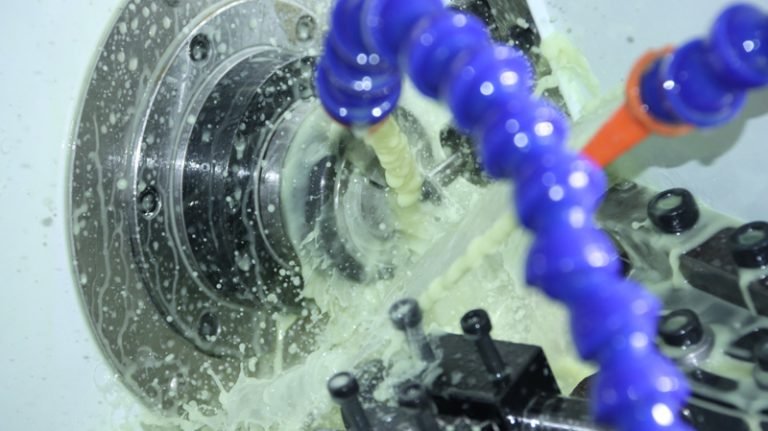
CNC turning is a machining process that involves the rotation of a workpiece while a cutting tool moves along one or two axes to remove material. This process is primarily used for producing cylindrical parts.
Advantages of CNC turning:
– Suitable for cylindrical parts: CNC turning is ideal for producing parts with rotational symmetry, such as shafts, rods, and bushings.
– Faster production times: For parts that can be produced using CNC turning, the process is often faster than CNC milling.
Limitations of CNC turning:
– Limited to cylindrical parts: CNC turning is not suitable for producing parts with complex geometries or features that cannot be produced by rotating the workpiece.
– Less versatile: CNC turning is less versatile than CNC milling processes, as it is limited to producing parts with rotational symmetry.
In conclusion, each CNC machining process has its unique capabilities, advantages, and limitations. 4-axis CNC machining offers greater flexibility and versatility compared to 3-axis CNC machining, allowing for the production of more complex parts with reduced setup times. However, 5-axis CNC machining provides even greater capabilities, making it suitable for producing parts with the highest levels of complexity. CNC turning, on the other hand, is ideal for producing cylindrical parts but is less versatile than CNC milling processes. When selecting the appropriate CNC machining process for a given application, it is essential to consider the specific requirements of the part, including its geometry, material, and production volume.