Metal penetration, liquid metal or metal oxides drill into the sand gap on the surface of the cavity through capillary penetration or vapor-phase penetration, and form a mechanically mixed adhesion layer of metal and sand on the surface of the casting.
Introduction of Metal Penetration
Metal penetration refers to the phenomenon of abnormal adhesion between sand and metal liquid in the casting process. Metal penetration is also called “iron sand”. The liquid iron penetrates into the pores between the sand particles, and after solidification, the sand particles are mechanically attached to the surface of the casting. This phenomenon may have an adverse effect on the casting process and the quality of the final castings. Metal penetration is a common challenge in the foundry industry and needs to prevent and resolve through proper process control and equipment maintenance.
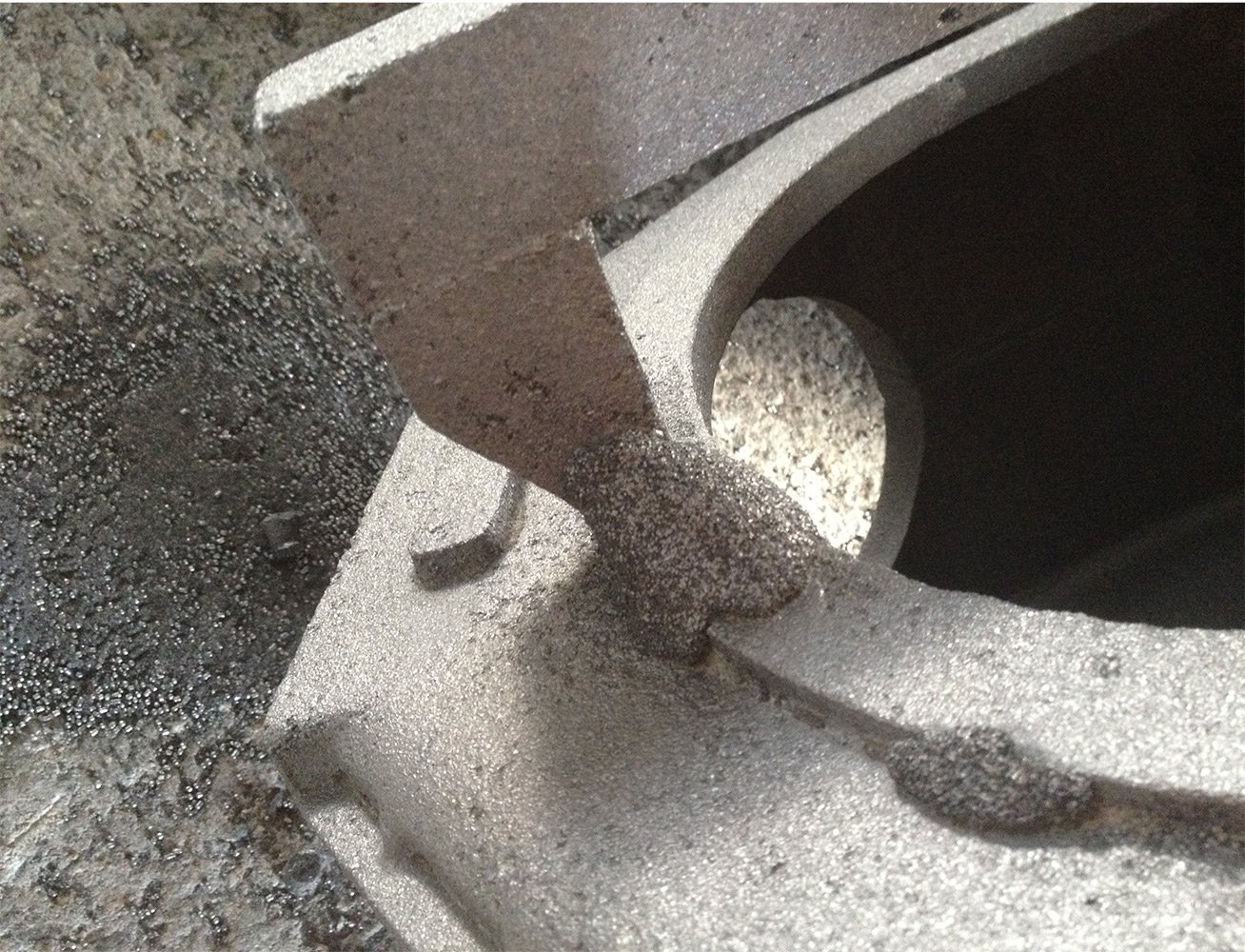
Manifestation of Metal Penetration
- Surface characteristics: Metal luster is visible on the surface of the casting, and the adhering sand particles form a spongy or slope-like structure. It is tightly combined with the casting, difficult to remove by conventional methods. This adhesive sand layer often has a certain thickness and hard texture.
- Distribution location: Mostly occurs in the casting by the thermal effect of strong and stress concentration of the region. Such as pouring risers near the mouth, the inner corner, grooves, and so on.
- Morphological description: Usually presented as a layer of uniform or uneven “iron sand”. That is, the sand particles are surrounded by liquid metal and solidified in the casting surface, forming an iron shell wrapped in the sand state.
- Quality impact: Metal penetration not only affects the appearance of the casting quality and dimensional accuracy, but also may damage the integrity of the internal structure. In addition, it will increase the difficulty of subsequent machining, and may lead to a decline in the mechanical properties of the castings.
Identification of Metal Penetration
- Observe whether there are obvious sand grain-like structure and visible metallic luster of sand layer on the casting surface. It is usually spongy or irregular in shape, and it combines tightly with the casting matrix to be not easily scraped off.
- Check the sand surface for abnormal adhesions such as metal shavings or other unusual deposits. Use a tool ( such as a small hammer or scraper) to remove the suspected sand adhering area. If the sand is tightly bound to the metal and difficult to separate, it may be metal penetration.
- Metallographic analysis can be used to determine the bond between the metal and the sand at a microscopic level. If the sand particles are covered by metal and tightly bonded, it indicates the existence of metal penetration.
- Abnormal vibrations and sounds may indicate metal penetration, especially during operation of the casting equipment. Additionally, tapping on the metal penetration area produces a solid sound that is different from the normal casting surface.
- If necessary, analyze the chemical composition of the suspected sand stripped off. Determine if it is the original sand material as a secondary judgment.
Causes of Metal Penetration
Casting metal penetration refers to the phenomenon of abnormal attachment between the metal liquid and the sand mold in the casting process. This may lead to metal liquid attached to the surface of the sand mold, affecting the surface quality and dimensional accuracy of the casting. The cause of metal penetration is complex and involves multiple factors.
- When pouring, the high temperature metal liquid generates great static and dynamic pressure on the sand mold. The high temperature of the liquid metal, the fast pouring speed or the complex structure of the casting leads to the increase of local pressure, which will cause the liquid metal to penetrate into the sand particles more easily.
- Improper particle size distribution, insufficient strength, poor refractoriness or bad air permeability of the sand. All these reasons may cause the liquid metal to penetrate and adhere to the sand more easily.
- Anti-adhesive coatings are of poor quality, unevenly applied or of insufficient thickness. This does not effectively isolate the liquid metal from the sand, allowing the liquid metal to directly attack the sand.
- Deep concave areas, sharp corners and transition zones with large wall thickness variations exist in the casting design. These areas are slow to dissipate heat so that the metal liquid stays for a long time, and it is more likely to occur metal penetration.
- Poor selection of gate and riser locations may increase the impact of the liquid metal on the sand. This promotes the sand particles to be involved in the liquid metal to form adhesion.
- Overcrowded molding arrangements can cause sand expansion in castings. Even if there is no significant sswell, metal penetration may occur.
Prevention of Metal Penetration
- Select the sand material suitable for specific casting process to ensure that it has good anti-adhesive properties and thermal stability.
- Adopt special sand type, such as zircon sand or olivine sand, in the parts where heat is concentrated, to improve its ability to suffer from heat for a long time or high-temperature radiation.
- Select raw sand with moderate grain size, good refractoriness and excellent air permeability to reduce the ability of metal liquid to penetrate into the sand.
- Use special sand type or tighter molding method to resist the penetration pressure of liquid metal into the sand type.
- Apply highly effective anti-sticking sand coatings and ensure that the coatings dry sufficiently to improve their refractoriness and high-temperature stability.
- Reasonable riser position and size to control the liquid metal static pressure. Distribute the impact force of liquid metal flow by buffer or diverter.
- Avoid overly complex casting structures and locations that are easy to generate large thermal stresses and thermal deformation, such as deep concave corners and narrow orifices. These locations are easily to cause the liquid metal long time stagnation and sand adhering occurs.
- Improve the consistency and accuracy of sand tightness to avoid localized over-tightening or over-loosening, which may lead to liquid metal infiltration.
Summary
Metal penetration is a common defect in the casting process. It is mainly manifested as the metal liquid penetrates into the sand particles under high temperature and high pressure, and forms a close adhesion with the casting surface after cooling. Its causes may involve many aspects, but there are also series of measures to improve or avoid the occurrence of metal penetration. Preventive measures mainly include optimizing raw materials and improving casting process. The specific operation may be a bit difficult for you, and it is necessary to seek the help of a specialized company like CYCO.
As a precision casting machining service provider with more than twenty years of experience, we carry out strict quality control on every casting process to ensure that all measures are effectively implemented. We always take our customers’ needs as our mission and do our best to manufacture excellent products that exceed your expectations. Our professional team and engineers are always available to answer your questions and provide technical support.
If you need high quality castings, please feel free to contact us!