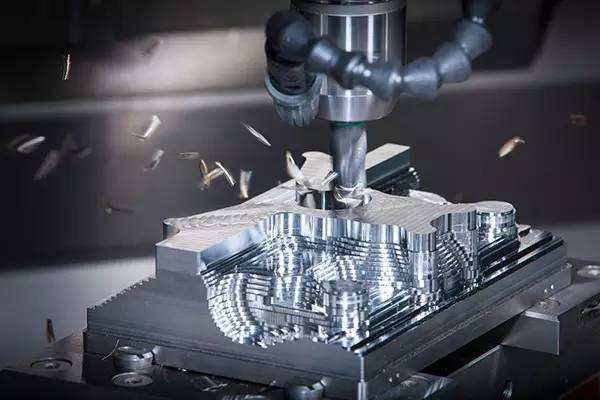
CNC machining is a subtractive manufacturing process that uses programmed code to control the movement of the tool axis. The programmed code includes all the necessary cutting parameters such as cutting tool movement, spindle speed, feed, RPM and more.
Engineers and machinists must understand cutting speeds and feed rates so that they can utilize them better in machining better.
Feed rate
What is feed rate
The distance traveled by the cutting tool during spindle rotation is known as the feed rate, which can also be referred to as the engagement speed of the cutting tool, and for milling operations, it is usually measured in in/min or mm/min. And for drilling and turning operations, it can be measured in inch/rev or mm/rev.
Variations in feed rate depend on the blank material ( such as steel, wood, aluminum, stainless steel), tool material ( like HSS tools, ceramics, ceramics), and other cutting factors (such as surface finish and the characteristics of the CNC machine tool).
The aesthetics of the machined product will depend on the feed rate, so feed rate optimization is critical in the CNC machining process.
Factors affecting feed rate
Every aspect of the CNC machining process is directly related to feed rate, such as safety, productivity, tool life, and product quality.
Consider the following factors when selecting a feed rate:
1. Productivity
For higher productivity, the feed rate can be increased by reducing the surface quality. In another situation, the cutting speed can be increased by keeping the feed rate stable.
2. Surface finish
Better surface finish can be achieved with lower feed rates, while higher feed rates can be considered for rough cutting.
For example, a feed rate of 0.01-0.05 mm/rev can be considered for finishing operations and 0.1-0.3 mm/rev for roughing operations.
3. Feed rate limitations
Existing machine tools have a one-by-one feed lever, within minimum and maximum limits. For these machines, exceeding the limits is not allowed.
4. Machine performance
Due to higher feed rates, high cutting forces and high vibrations are experienced. The feed rate must be selected according to the absorption and transmission of the machine tool.
Cutting speed
What is cutting speed
The relative speed between the cutting tool and the surface of the workpiece, it can also be defined as the linear distance traveled by the cutting tool on the surface of the workpiece during the cutting process.
The main parameters of CNC machining will be determined by the cutting speed such as power consumption, cutting temperature and tool life.
The cutting speed will vary depending on the material such as high carbon steel, low carbon steel, aluminum and plastics.
Factors affecting cutting speed
In order to obtain optimum output from a CNC machining process, it is necessary to ensure optimum cutting speed.
The optimum cutting speed for a CNC machining process can be predicted by the following factors:
1. Hardness of workpieces
Cautions must be maintained with harder workpieces during machining, as they can easily worsen the performance of the tool.
When machining harder materials, slower cutting speeds must be used. For example, titanium has a lower cutting speed compared to steel.
2. Strength of cutting tools
The strength of cutting tools plays a vital role in cutting speed.
For example, cutting tools made of high-strength materials such as diamond and boron nitride can be used for higher cutting speeds.
On the other hand, for lower cutting speeds, cutting tools made of HSS can be used.
3. Tool life
At higher cutting speeds, softer tool materials will wear out quickly, which will result in shorter tool life.
Another key factor in determining the cutting speed includes parameters such as tool cost and the number of parts to be produced. If these parameters are within the permissible limits, then a high cutting speed can be used.
Why are cutting speed and feed rate important in machining?
1. Determine the rate and amount of material to be removed.
2. Affect the tool life greatly.
3. If there is a small difference between the cutting speed and the feed rate, the cutting tool may break.
4. To achieve a better surface finish.
Difference between cutting speed and feed rate
While both feed rate and cutting speed affect the performance of the machine as a whole, they actually refer to two different things. In order to get the best results from your CNC machine, it’s important to understand the difference between the two.
1. The main difference between feed rate and cutting speed is that feed rate is the speed at which the tool moves through the workpiece, while cutting speed is the speed at which the cutting edge of the tool moves.
In other words, feed rate is a measure of how fast the tool moves through the material, while cutting speed is a measure of how fast the tool actually cuts.
2. Cutting speed affects cutting force and power consumption, but feed rate does not.
3. Cutting temperature, tool wear and tool life are less affected by feed rate, but cutting speed can have a significant effect.
4. The fan or feed marks produced on a machined surface are not directly related to the cutting speed. However it is related to the feed rate, which will directly represent the surface roughness.
How to determine feed rate and cutting speed?
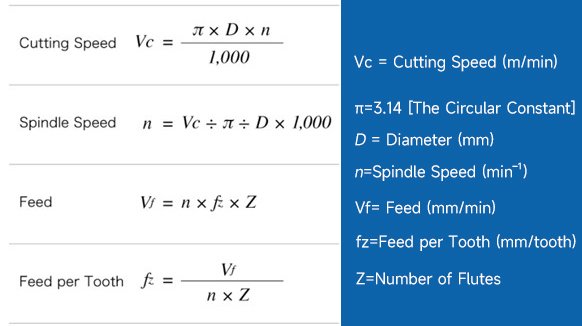
The above chart shows all the necessary parameters involved in determining the cutting speed and feed rate.
To determine the cutting speed and feed rate, the spindle speed is the basic requirement. The final feed rate can be obtained in two ways, first by determining the feed rate of each tooth and then using the feed rate of each tooth to determine the feed rate of the cutting tool.
Other considerations
1. Spindle speed limit
2. Nonlinearity paths
3. Interaction of cutting speed and feed rate
Conclusion
If you are struggling to choose the right cutting speed and feed rate for your CNC machined parts, please contact CYCO, our experienced engineers and machinists are skilled in different machining operations and can fulfill different machining needs to ensure that the parts and products you need are manufactured.
In order to avoid wasting your valuable time, you can choose CYCO as your partner without any hesitation!
Work with us for a worry-free experience now!