A bearing is a mechanical element used to support a rotating shaft, which reduces friction between the shaft and the housing and allows the shaft to rotate smoothly.
There are various types of bearings available, each designed for a specific application. In this article, we will focus on plain and rolling bearings.
What is a Bearing
A bearing is a mechanical element used to support a rotating shaft and reduce friction between moving parts. It plays a vital role in mechanical equipment to ensure that the machine or equipment runs smoothly, efficiently and accurately. By providing a smooth interface between moving parts, bearings help to minimize wear and tear and heat generation, thereby increasing efficiency and durability.
Main Functions of Bearings
Support and Localization
Bearings support the rotating shafts in a mechanical system and ensure that the shafts rotate in the correct position of their own. They help maintain the relative positions of the various components in the system, allowing the mechanical system to operate on its normal trajectory. High-quality bearings ensure positional accuracy and motion stability of rotating parts, which is critical for precision instruments and high-speed equipment.
Friction Reduction
Through the design of rolling elements (balls or rollers) or sliding surfaces, bearings reduce the friction between the shaft and the housing, making the machine run more smoothly, which reduces system energy loss and improves efficiency.
Transmission of Loads
The bearings are able to withstand axial and radial loads from different directions, ensuring stable operation of the rotating shaft under load and enabling the mechanical system to safely withstand external loads.
Vibration and Noise Reduction
High-quality bearings can effectively reduce the noise and vibration generated during mechanical operation, improve the operating environment and equipment performance, and enhance the smoothness and quietness of mechanical systems.
Transmission of Torque
In some applications, bearings can transmit torque, enabling different parts of a mechanical system to perform rotational movements.
Extended Life
Bearings prevent wear and damage to shaft journals, extending the life of shafts and other related components. In addition, proper selection, installation and maintenance of bearings can help extend the life of a mechanical system.
Plain Bearing
A plain bearing is a mechanical bearing that provides support and reduces friction between two oppositely moving surfaces. Plain bearings are usually made of metallic or non-metallic materials that have good wear resistance and self-lubricating properties to withstand loads and allow the shaft to rotate freely within them.
Plain bearings work by sliding between bearing surfaces to support and reduce friction. Unlike rolling bearings, there are no rolling elements in a plain bearing and rolling is not used. A plain bearing usually consists of two surfaces that rub against each other, one of which is the inner ring of the bearing and the other is the outer ring or seat of the bearing. The sliding between these two surfaces is usually provided by a lubricant (oil or grease).
To reduce this friction, and to minimize wear, plain bearings usually require a lubricant (oil or grease), and sometimes a solid lubricant (graphite or PTFE).
Components of a Plain Bearing
Journal: Also known as the shaft, it is the rotating part mounted on the bearing.
Bearing housing or pad: Usually a component made of cast iron, bronze or steel that supports the journal and carries the load. It has an inner surface that contacts the journal and provides a smooth sliding surface.
Bearing lining: A thin, hard layer of material, such as bronze, pasteurized alloy (white alloy), carbon graphite, embedded in the inner surface of the housing to reduce friction and wear.
Lubrication system: Includes oil grooves, oil holes, and grease nipples for injecting lubricants, such as oil or grease, into the bearing to reduce friction and carry away heat.
Seals: Such as dust caps or oil seals, which are used to prevent dust, dirt and other impurities from entering the inside of the bearing while keeping the lubricant from leaking.
Advantages of Plain Bearing
Simple Construction
Plain bearings are relatively simple in design, and because there are no rolling elements, they are often easier to manufacture and maintain than rolling bearings. Plain bearings usually have a longer service life, especially when manufactured using high-performance materials.
High Load Capacity
Plain bearings are usually able to withstand high loads, especially in the radial direction. This makes them suitable for some heavy-duty applications, such as heavy machinery and equipment.
Good Wear Resistance
As the sliding surfaces are usually lubricated, plain bearings have good wear resistance, which reduces wear and prolongs service life to a certain extent.
Low Noise
Plain bearings usually produce low noise levels when they are in operation because there are no moving metal parts touching and rubbing against each other, which makes them suitable for some applications with high noise requirements, such as home appliances, office equipment, and so on.
Highly Adaptable
Because there are no rolling elements involved in plain bearings, plain bearings can be adapted to a wide range of operating conditions, including high and low temperatures, high humidity, corrosive environments, and can work on irregular surfaces or large journal sizes.
Low Cost
Plain bearings are relatively inexpensive to manufacture and require less material. In addition, because of their long maintenance intervals, the overall cost is also lower.
Disadvantages of Plain Bearing
Friction Loss
Plain bearings work by supporting the shaft through sliding friction and usually have a higher friction loss compared to rolling bearings. This means that they generate more heat and wear during operation.
Limitations for High-Speed Applications
Due to their high friction and potential heat problems, plain bearings are not suitable for use in applications that require high speed rotation. In high-speed applications, friction can cause the bearing to overheat.
High Maintenance Requirements
Plain bearings rely on lubricants to minimize friction and wear to maintain good performance, so they require regular maintenance and lubricant replacement. Insufficient or failed lubrication can lead to bearing failure.
High Machining Requirements
In order to achieve good performance, the surface of a plain bearing must be very smooth, which can increase manufacturing costs.
Rolling Bearing
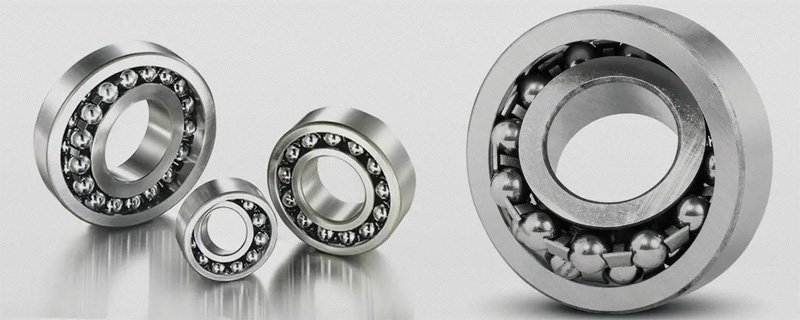
A rolling bearing is a mechanical element used to support a rotating shaft by rolling to reduce friction inside the bearing. The principle of operation is that loads are transferred and friction is reduced by rolling elements (balls, rollers or needles) rolling between the inner and outer rings. These rolling elements are guided by a cage to maintain the correct spacing and orientation to ensure smooth and efficient operation.
Depending on the type of load, speed requirements and application environment, rolling bearings are available in a wide range of types and designs, such as deep groove ball bearings, cylindrical roller bearings, angular contact ball bearings, self-aligning ball bearings, needle roller bearings, and so on.
Components of Rolling Bearing
Usually consists of the following main parts:
Inner ring: the inner part of the bearing, usually affixed to the rotating shaft in the form of a ring, made of metal or other materials.
Outer ring: the outer part of the bearing, also in the form of a ring, which is affixed to the housing (usually the shell of a machine) and is made of metal or other material.
Rolling body: the part located between the inner ring and outer ring, used to reduce friction inside the bearing. Common rolling bodies include spheres, balls and rollers.
Keeper: used to maintain the relative position of the rolling body structure, to prevent the rolling body collision with each other or vibration. There are many different designs of cages, commonly made of metal or plastic.
In addition to these basic components, some other auxiliary parts may be included:
Seals: used to prevent dirt and contaminants from getting inside the bearing.
Lubrication system: to ensure that the friction surfaces inside the bearing are always well lubricated.
Advantages of Rolling Bearing
Low Friction
Rolling bearings have rolling elements (balls or rollers) that roll between the inner and outer rings to reduce friction. This results in lower friction, lower energy loss and less heat generation compared to plain bearings, which improves efficiency.
High Speed
Due to the lower friction, rolling bearings are suitable for high speed rotating applications. The rolling motion of the rolling elements reduces heat generation and helps to counteract the heat that may be generated at high speeds.
High Load Carrying Capacity
The rolling elements of rolling bearings are distributed over the entire length of the bearing to share the load evenly, enabling the bearing to withstand large axial and radial loads while maintaining good stability and accuracy.
Versatility
There are various types of rolling bearings, including deep groove ball bearings, tapered roller bearings and cylindrical roller bearings, which can be selected according to the specific application requirements.
Long Service Life
Due to low friction, high precision and relatively easy lubrication, rolling bearings usually have a long life.
Disadvantages of Rolling Bearing
Noise and Vibration
Rolling bearings may generate noise and vibration at high speeds, especially at high loads and speeds. This can be a disadvantage for some applications where noise is critical, and can also negatively affect the performance of certain precision instruments and equipment.
Failure Modes
Rolling bearings have rolling elements in contact with the inner and outer rings. Insufficient lubrication or contamination may lead to wear of the balls or rollers, or even failure modes such as pitting.
Sensitivity to Contaminants
Once contaminants or foreign matter enter the interior of a rolling bearing, it may lead to early damage or failure.
Mounting and Maintenance
Although less demanding to maintain than plain bearings, rolling bearings still require periodic inspection of the lubrication condition and replacement of the lubricant when necessary. In addition, the mounting of rolling bearings can be more complex than that of plain bearings, with the need to ensure correct alignment and appropriate preload.
Less Adaptable
Rolling bearings may be less adaptable than plain bearings at certain low speeds, high loads, high temperatures or under severe operating conditions. In these special operating conditions, more complex and expensive designs may be required.
Plain Bearing Vs Rolling Bearing
Plain and rolling bearings are two common types of mechanical bearings, and they each have advantages and disadvantages in engineering applications.
The following is a key comparison between plain and rolling bearings:
Friction
Plain bearings: The shaft is supported by direct contact and the friction is mainly sliding. Sliding friction is usually higher in comparison with rolling bearings.
Rolling bearings: Rolling between the inner and outer rings by means of rolling elements, the friction is lower. This contributes to increased efficiency and reduced energy losses.
Start-up Friction
Plain bearings: May generate high friction during start-up and require a high starting torque.
Rolling bearings: Generally have less starting friction and require less starting torque.
Speed
Plain bearings: Suitable for applications with relatively low speeds, where excessive friction and heat may be generated at high rotational speeds.
Rolling bearings: Suitable for applications with high speeds, as the lower rolling friction helps to reduce heat generation.
Accuracy
Plain bearings: Relatively low accuracy, suitable for applications where accuracy is not critical.
Rolling bearings: Provide a high degree of accuracy and are suitable for applications that require precise positioning and localization, such as machine tools.
Load Carrying Capacity
Plain bearings: Able to withstand high loads, especially in the radial direction.
Rolling bearings: Also have a high load carrying capacity and are suitable for a wide range of load directions.
Lifetime
Plain bearings: May have a shorter life at high loads and speeds and require more frequent maintenance.
Rolling bearings: Generally have a longer life and are suitable for applications where a longer life is required.
Maintenance
Plain bearings: Relatively simple maintenance, usually involving lubrication and inspection of seals.
Rolling bearings: Require regular lubrication, but maintenance is slightly more complex than for plain bearings.
Adaptability
Plain bearings: Better adapted to some high temperatures, harsh environments or applications involving vibration and shock.
Rolling bearings: More suitable for high speed, high precision and some special working conditions.
Applications of Bearings
Bearings are widely used in a variety of industrial and mechanical systems to provide support and guidance to rotating parts.
The following are some of the common application areas for bearings:
Automotive
Bearings play a key role in the automotive field and are used in engines, transmissions, wheels, steering systems and other parts. Rolling bearings are commonly found in wheel bearings, engine crankshaft bearings, and so on.
Industrial Machinery
Bearings are used to support and guide rotating parts in various industrial machinery and equipment, such as motors, pumps, fans, compressors, and others.
Aerospace
Aircraft engines, landing gear and other flight control equipment rely on high quality bearings to ensure safety and reliability.
Machine Tools and Manufacturing Equipment
Whether it’s a large CNC machine tool or a small machining center, bearings are critical components that support rotating axes and maintain high accuracy.
Railroad Transportation
In the field of railroad transportation, bearings are widely used in train wheels, transmission systems and various connecting parts.
Medical Equipment
In the medical industry, some medical equipment, such as scanners and operating tables, also need bearings to ensure the normal operation of the equipment.
Robotics
Industrial robots often use ball or roller bearings in the joints and rotating parts of the arm to provide stable support.
Fitness Equipment
The drive systems of exercise bikes, treadmills and other exercise equipment rely on high-quality bearings to provide a smooth operating experience.
Household Appliances
From washing machines to refrigerators, many appliances contain motors that rely on various types of bearings.
Summary
Bearings can be found in almost all mechanical devices and systems, and they are an indispensable basic component of modern industrial society. Both plain and rolling bearings play an important role in a variety of mechanical systems, and each has its own advantages and applications.
Choosing the right type of bearing depends on factors such as load capacity, speed requirements, cost considerations and maintenance. By understanding the characteristics and differences between plain and rolling bearings, you can make an informed decision to optimize the performance and life of your machinery and equipment.
CYCO offers a wide range of CNC machining services including machining of all types of bearings. If you are interested in bearings, please feel free to visit our website or contact us directly to learn what you want to know about bearings.
Since CYCO has more than two decades of experience in precision machining and manufacturing, you can trust us completely. Working with us is definitely a completely right decision.
Related Reading: How Much Clearance Does A Bearing Need