The convergence of 3D printing and casting creates endless possibilities for manufacturing. It achieves the perfect combination of complex structures, customization and efficient production.
Basic Principles
3D Printing
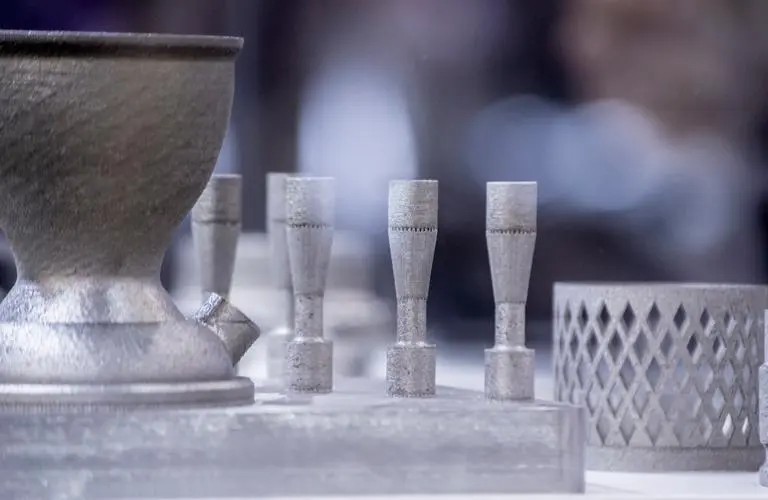
3D printing, also known as additive manufacturing, is an advanced manufacturing technology. It transforms digital models directly into solid three-dimensional objects by stacking materials layer by layer. Unlike traditional manufacturing methods that create objects by removing excess from raw materials, it adds materials layer by layer. It transforms a CAD file into a series of two-dimensional slices of information, which are then printed in layers by a 3D printer.
The specific steps of 3D printing are as follows:
- Modeling: Create or obtain a 3D digital model through CAD software.
- Slicing: The 3D model is broken down into a series of thin layers, known as slices. Each slice represents a cross-section of the object at a certain height.
- Path planning: Generate a path for each slice to accurately stack materials.
- Layer-by-layer construction: The printer stacks the material layer by layer based on the path planning. Depending on the 3D printing technology, this can be done with fused plastic, powder or liquid resin.
Fused deposition modeling (FDM): A printhead heats and sprays molten plastic, building objects layer by layer by controlling the trajectory of the printhead.
Photocuring (SLA, DLP): Use an ultraviolet light source to irradiate a liquid photosensitive resin, causing it to solidify layer by layer to form an object. (SLA refers to stereo lithography appearance. DLP stands for digital light processing.)
Sintering of powder (SLS): Use a laser or other energy source to sinter powdered materials layer by layer, bonding them into a solid. (SLS means selective laser sintering.) - Curing and post-processing: Performs additional post-processing steps, such as drying, cleaning, or surface treatment, to obtain the final and complete product.
Casting
Casting is an old and basic manufacturing process. It is a manufacturing process where molten metal is injected into a mold and cooled to form a part or product of the desired shape. Depending on the application requirements, casting methods can be categorized into various types: (including but not limited to the following)
Sand casting: Pour the molten metal into a cavity-like sand mold and allow it to solidify. The sand mold consists of sand particles and an inorganic binding agent. When the metal has cooled to room temperature, open the sand mold and remove the casting. It is suitable for the production of castings of all sizes and complexity. The most common technique is to use a pair of boxes filled with sand to form the sides of a cavity. The various types of sand used in this process have a melting temperature well above the liquefaction temperature of the metal. (If you want to know more, click here)
Permanent mold casting: The process of transferring molten metal into a metal mold with the help of gravity and ensuring that the metal solidifies in the mold. Molds are usually made of metallic materials such as iron, steel, aluminum or copper. These materials have good thermal stability and wear resistance. They are able to withstand the impact of hot molten metal and transfer heat efficiently to promote rapid cooling and uniform solidification of the casting. If a sand or plaster core is used in permanent mold casting, it is known as semi-permanent mold casting. It is usually used for high precision or mass production. (If you want to know more, click here)
Die Casting: Inject a liquid metal or alloy under high pressure into a mold where it cools and solidifies to form the desired product shape. Die casting is a highly efficient metal forming process. Usually used in mass production, it is particularly suited to the manufacture of metal parts with complex shapes and high precision. (If you want to know more, click here)
Investment casting: An advanced metal manufacturing process used to produce metal parts with complex shapes and high precision. It uses fusible materials (such as waxes and plastics) to make a mold of the part, and then covers the surface of the model with a layer of fire-resistant paint to form a molten mold. When the mold dries and hardens, melt or sinter the model inside, creating a cavity inside the shell that conforms to the shape of the part. Eventually, pour molten metal into the cavity to create complex shapes and high-precision metal parts. (If you want to know more, click here)
How 3D Printing Changes Casting
3D printing brings a profound impact on casting. Here are a few key aspects of how 3D printing changes casting:
- Increased design flexibility: 3D printing allows engineers to design more complex, geometrically flexible parts. These parts may be difficult to manufacture by traditional casting methods. This provides greater design freedom and helps optimize part performance.
- Rapid prototyping: 3D printing enables rapid prototyping, which reduces product development cycles and helps bring new products to market faster.
- Small batch and customized production: While traditional casting is usually more suitable for mass production, 3D printing is more flexible. It can handle small-lot production and even single-piece customized production needs cost-effectively. This makes production more flexible and can be personalized according to customer needs.
- Reduced waste: Traditional casting may require large amounts of raw materials. This is because parts are usually formed by cutting or extruding, which generates a lot of waste. In contrast, 3D printing enables adding materials on demand. This reduces waste generation and improves material utilization.
- Supports complex structures and lightweight designs: 3D printing enables more complex and lightweight structural designs. Reducing the weight of parts while maintaining strength. This is important for some high-end industries such as aerospace and automotive manufacturing.
- Process optimization: 3D printing is part of digital manufacturing. The combination of digital design and virtual simulation helps in process optimization and efficiency. This makes the production process smarter and more automated.
- New materials and functional design: 3D printing promotes the development of new materials, some of which are specifically designed for use in specific 3D printing processes. This provides more material choices for products and supports more application areas.
- Repair and remanufacturing: For damaged or upgraded castings in need of modification, 3D printing can accurately replicate or repair them based on the original 3D scan data.

Limitations of 3D Printing Combined with Casting
Despite the multiple advantages of using 3D printing combined with casting, there are some limitations and challenges:
- Material property limitations: 3D printing and traditional casting use different materials. 3D printed materials may be limited in terms of strength, heat resistance, and so on. While casting typically involves a wider choice of materials. This may limit the possibility of combined use in some applications.
- Relatively slow production speed: 3D printing is slow to produce relative to some traditional manufacturing methods. In the case of mass production, it may take longer to complete production. This can be a challenge for some industries that require high production volumes.
- Equipment and process complexity: The combination of 3D printing and casting requires special equipment and processes, which adds to the complexity of the production system. Maintenance and operation of these systems brings additional costs.
- High investment costs: Purchase of advanced 3D printing equipment and casting equipment may be a burden for some small and medium-sized enterprises.
- High material costs: 3D printing materials are usually relatively expensive, especially some high-performance metals or advanced plastics. In the case of mass production, compared with traditional casting may not be economical enough.
- Limited applicability: Not all products or industries can benefit from the combination of 3D printing and casting. Some designs may not be suitable for the casting process, while some casting processes may need to be specifically adjusted to fit the particular requirements of 3D printing. Some traditional mass production areas, such as automotive manufacturing, may still be more suitable for using traditional casting processes.
- Size limitations: At present, some 3D printing technologies have certain print size limitations. For large-size castings, 3D printing may be limited to mold manufacturing or supplemental production of some parts.
- Process maturity: 3D printing in the microstructure control, internal defect control and post-treatment processes need to further improve the technology.
Applications
Aerospace
Complex aero-engine components, aircraft structural parts and spacecraft parts often have precise internal structures that require highly customization. The design and manufacture of complex geometries can be achieved by creating casting molds through 3D printing technology.
Automotive Manufacturing
The need for lightweighting in the automotive industry is driving the combination of 3D printing and casting technologies. It is used to produce high-performance alloy castings ( such as turbocharger housings, brake system parts) as well as customized, low-volume parts.
Medical
3D printing is capable of accurately replicating the human anatomy. It plays an important role in medical modeling, surgical guide design, and the production of prosthetics and implants. These medical devices are 3D printed and cast to obtain biocompatible metal or alloy products.
Energy Devices
Some of the key components of nuclear, wind, and solar energy equipment are subject to extreme environmental conditions. The combination of 3D printing and casting can optimize product design and reduce production costs, as well as improve the efficiency of energy conversion.
High-end Equipment Manufacturing
Industrial robots, precision instrumentation parts often require high precision and complexity. 3D printing technology for mold manufacturing provides an innovative solution to the traditional casting process.
Summary
The combination of 3D printing and casting technology is gradually changing and optimizing the traditional casting industry. This combination not only significantly increases design freedom, but also shortens the product development cycle. In addition, precisely printed molds reduce costs and improve material utilization. In practice, 3D printing and casting technology is widely used in many fields. High-precision molds made quickly by 3D printing can produce high-performance parts. However, this combination is not without limitations. With technological advances and innovations, it is expected to promote a deeper integration of 3D printing and casting technology and further expand its applications in various fields.
If you are interested in the combination of 3D printing and casting, you can contact us. We, CYCO, have over twenty years of experience in precision machining and manufacturing. We specialize in working with various materials and machining processes, including precision casting machining and 3D printing. Whether or not to use 3D printing technology in your casting project will be determined by your actual needs. Our dedicated engineers will choose the most appropriate machining method for your project. If you have an idea to start a new project, please feel free to contact us!